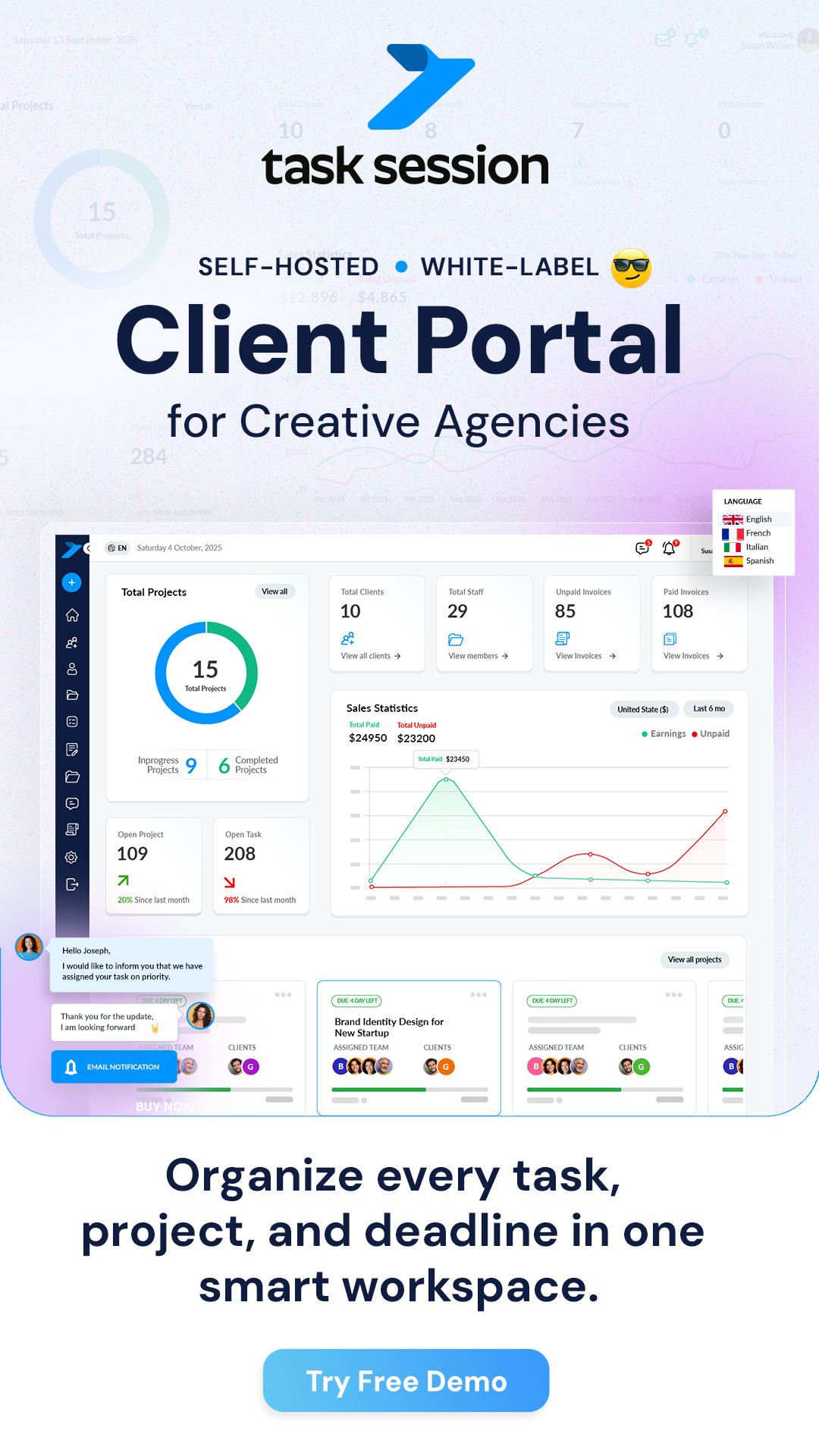
Clients are at the centre of everything you do in Task Session. Every project, invoice, and deliverable connects back to a client profile. This guide covers how to create client profiles, fill in their contact and company details, associate them with projects, manage multiple contacts per organisation, and keep your client list clean and organised as your business grows.
Who this guide is for: Admins who manage client relationships within Task Session.
What you will need: Admin-level access. SMTP/email configured if you want clients to receive automatic login invitations.
How Clients Work in Task Session
In Task Session, a “client” is not just a name in a contact list — it is a full CRM record that connects to every part of the platform. When you create a client profile, that profile becomes the central link between:
- Projects — the client is assigned to one or more projects, giving them visibility into the work being done for them.
- Invoices — invoices are tied to the client profile, so billing history stays organised and traceable.
- Files — project files shared with the client are accessible through their Client Portal.
- Communication — messages and project discussions are associated with the client’s context.
- Client Portal — the client logs in and sees only the projects, tasks, files, and invoices that belong to them.
Think of each client profile as a container that holds everything related to that client relationship — past, present, and future.
Creating a New Client Profile
Step-by-Step
- Log in to Task Session with your Admin account.
- Navigate to the Clients section from the main navigation menu.
- Click Add Client (or the equivalent button in your version).
- Fill in the client’s details (see the field reference below).
- Set the client’s permissions — choose what they can see and do in the Client Portal.
- Click Save.
Once saved, Task Session automatically sends the client an email with their login credentials and a link to the Client Portal (provided SMTP is configured).
Client Profile Fields
| Field | Required? | Purpose |
|---|---|---|
| Full Name | Yes | The primary contact person’s name. This appears on tasks, invoices, chat messages, and throughout the portal. |
| Email Address | Yes | Used for login credentials, onboarding email, notifications, and invoice delivery. Must be unique per account. |
| Company / Organisation | Recommended | The client’s business name. Appears on invoices and helps you identify client accounts when multiple contacts share a company. |
| Phone Number | Optional | Stored in the client profile for your reference. Not used by the system for any automated function. |
| Address / Billing Address | Optional | Useful for invoice accuracy. If your invoices include a billing address, enter it here so it auto-populates. |
| Notes | Optional | Internal notes about the client — preferences, communication style, account history. Visible only to your team, never to the client. |
| Permissions | Yes | Controls what the client can see and do in the portal — projects, tasks, files, invoices, communication, and review/approval access. |
Tip: Fill in as much detail as possible when creating the profile. Complete client records save time later when generating invoices, reviewing project history, or handing off account management to another team member.
Associating Clients with Projects
A client profile on its own does not automatically show the client any work. You need to explicitly assign the client to one or more projects. This is how Task Session controls what each client sees in their portal.
Assign a Client During Project Creation
- Go to the Projects section and click Create Project.
- Fill in the project details — name, description, deadline.
- In the Client field, search for and select the client you want to associate with this project.
- Assign team members in the Team field.
- Save the project.
The client now has access to this project in their portal (subject to their permission settings and the internal/client-visible toggles on individual items).
Assign a Client to an Existing Project
- Open the project from the Projects section.
- Go to the project’s settings or details view.
- Find the Client assignment field.
- Search for and add the client.
- Save.
What Happens When You Assign a Client
| What Happens | Details |
|---|---|
| Project appears in the Client Portal | The client can see the project name, status, and overview when they log in. |
| Client-visible tasks become accessible | Any tasks within the project that are marked as client-visible will appear to the client. Internal-only tasks remain hidden. |
| Shared files become accessible | Files shared at the project level can be viewed and downloaded by the client (if file permissions are enabled). |
| Invoices linked to the project are visible | If you create an invoice tied to this project and client, it appears in their portal invoice section. |
| Email notification may be sent | Depending on your notification settings, the client may receive an email alerting them that they have been added to a new project. |
Key concept: Assigning a client to a project does not mean they see everything in that project. It means they have access to the project container. Within that container, individual tasks, files, and discussions are still controlled by the internal/client-visible toggle. This two-layer approach gives you precise control over the client experience.
Managing Multiple Contacts for One Company
It is common to work with several people at the same client organisation — a marketing director, a project lead, and a finance contact who handles invoices. Task Session supports this by allowing you to create separate client accounts for each contact person.
How to Set This Up
- Create a separate client profile for each contact person at the company. Use the same company name in the Company field for all of them.
- Set permissions individually for each contact based on their role:
- The project lead might need access to tasks, files, chat, and review/approvals.
- The finance contact might only need access to invoices and payment functionality.
- A senior executive might only need a high-level project overview.
- Assign all relevant contacts to the same project(s).
Each person gets their own login, their own view of the portal, and their own permission level — even though they all belong to the same client organisation.
Example: Creative Agency with a Corporate Client
You are redesigning a brand identity for Acme Corp. You create three client accounts: Sarah (Marketing Director) — full access with review and approval rights. James (Project Coordinator) — task and file access, plus chat for day-to-day communication. Lisa (Accounts Payable) — invoice and payment access only. All three are assigned to the “Acme Corp Brand Refresh” project. Each sees exactly what they need and nothing more.
Editing Client Information
Client details change — companies rebrand, contacts switch email addresses, billing addresses get updated. You can edit any client profile at any time without affecting their project history or associated data.
Step-by-Step
- Go to the Clients section.
- Find the client you want to update — use the search or browse the list.
- Click on the client’s name or the Edit option.
- Update any fields — name, email, company, phone, address, notes, or permissions.
- Click Save.
Changes take effect immediately. A few things to keep in mind:
- Email change: If you update the client’s email address, they will need to use the new email to log in. Notify them directly so they are not locked out.
- Name change: The updated name will reflect across tasks, invoices, chat history, and the portal.
- Permission change: Updated permissions take effect on the client’s next page load or login. If you are restricting access, the client will immediately lose visibility to anything you have removed.
Caution with permission changes: If a client is actively reviewing deliverables or in the middle of a payment, avoid changing their permissions mid-process. Wait until they have completed their current action, then adjust access. Sudden permission changes can create confusion and erode client trust.
Removing a Client from a Project
If a client is no longer involved in a specific project — the engagement has ended, the project has been completed, or they were assigned by mistake — you can remove them from the project without deleting their account.
- Open the project from the Projects section.
- Go to the project’s settings or details view.
- Find the Client assignment field.
- Remove the client from the assignment.
- Save.
Once removed:
- The project disappears from the client’s portal — they can no longer see it, its tasks, files, or discussions.
- The client’s account remains active — they can still access other projects they are assigned to.
- Historical data is preserved — any comments the client made, files they uploaded, or reviews they submitted within the project remain intact in your admin view.
When a Client Relationship Ends
When a client engagement wraps up, you have three options. Choose the one that fits the situation.
| Action | When to Use | What Happens |
|---|---|---|
| Remove from project only | One project is done, but the client has other active projects or may return. | Client loses access to that specific project but retains their account and portal access for other projects. |
| Deactivate the client account | All work with the client is complete. No active projects remain. | Client cannot log in. All data (tasks, invoices, files, chat) is preserved. Account can be reactivated later if the client returns. |
| Delete the client account | Rarely recommended. Only if you need to permanently remove the record and accept potential data loss. | Client is removed from the system. Associated records may become orphaned or deleted depending on the version. |
Reminder: Task Session includes unlimited users on every plan. Keeping a deactivated client account costs you nothing — there are no per-seat fees. Always prefer deactivation over deletion to preserve your complete project and billing history.
Best Practices for Managing Your Client List
1. Standardise Company Names
When multiple contacts belong to the same organisation, use the exact same company name for each profile. This makes it easy to search, filter, and identify which contacts belong together. Avoid variations like “Acme Corp”, “Acme Corporation”, and “ACME” for the same company.
2. Add Internal Notes Generously
The notes field on a client profile is visible only to your team. Use it to record details that help with account management — preferred communication channel, timezone, billing quirks, key dates, or anything your team should know before reaching out.
3. Set Permissions at Onboarding
Decide what the client should access before you save their profile and trigger the invitation email. It is better to start with appropriate permissions from day one than to grant broad access and restrict it later — clients notice when access is taken away.
4. Use Projects as the Organising Layer
If a long-term client has multiple engagements, create a separate project for each engagement rather than lumping everything into one project. This keeps timelines, invoices, and deliverables cleanly separated. The client sees each project individually in their portal.
5. Archive Completed Projects, Deactivate Finished Clients
Build a habit of archiving projects when they are done and deactivating client accounts when no active work remains. This keeps your active lists clean while preserving everything for future reference. A quarterly review of your client list is a good practice — look for active accounts with no assigned projects and consider deactivating them.
6. Verify Email Addresses Before Saving
Since the client’s email is used for login, notifications, and invoice delivery, a typo means the onboarding email goes to the wrong person (or nobody). Double-check the email address before saving a new client profile.
Quick Reference
| Task | Steps Summary |
|---|---|
| Create a new client | Clients ? Add Client ? Fill details ? Set permissions ? Save |
| Assign client to a project | Projects ? Open project ? Client field ? Add client ? Save |
| Edit client details | Clients ? Select client ? Edit fields ? Save |
| Change client permissions | Clients ? Select client ? Adjust permission settings ? Save |
| Remove client from a project | Projects ? Open project ? Client field ? Remove client ? Save |
| Deactivate a client | Clients ? Select client ? Deactivate ? Confirm |
| Reactivate a client | Clients ? Filter inactive ? Select client ? Set Active ? Save |
| Add multiple contacts for one company | Create separate client profiles with the same Company name ? Set individual permissions ? Assign all to the same project(s) |
Frequently Asked Questions
Is there a limit to how many clients I can add?
No. All Task Session plans include unlimited client accounts. You can add as many clients as your business requires — there are no per-seat charges for clients or any other user type.
Can a client be assigned to multiple projects?
Yes. A single client can be associated with as many projects as needed. Each project appears separately in the client’s portal, and the client can switch between them.
Can multiple clients be assigned to the same project?
Yes. A project can have more than one client. This is useful for joint ventures, partnerships, or situations where multiple stakeholders need visibility into the same body of work. Each client sees the same client-visible content, subject to their individual permissions.
What if I enter the wrong email address for a client?
Edit the client profile immediately and correct the email. If the onboarding email was already sent to the wrong address, the unintended recipient would need the correct portal URL and password to access anything — so the risk is low, but it is best to fix it quickly. After correcting the email, you can resend the invitation or have the client use the password reset function.
Can clients see other clients in the system?
No. Client accounts are isolated from each other. A client only sees their own projects, tasks, files, and invoices. They have no visibility into other clients, other projects they are not assigned to, or any internal team information.
Can I import clients in bulk?
Bulk import availability depends on your Task Session version. If the feature is available, look for an import option in the Clients section that accepts CSV files. If it is not available, clients need to be added individually. For large migrations, consider reaching out to Task Session support for guidance.
Do clients receive an automatic welcome email?
Yes — when you create a client profile and save it, Task Session sends an onboarding email with login credentials and a portal link. This requires SMTP to be configured. If the client does not receive the email, see Email Notifications Not Working? Here’s How to Fix It.