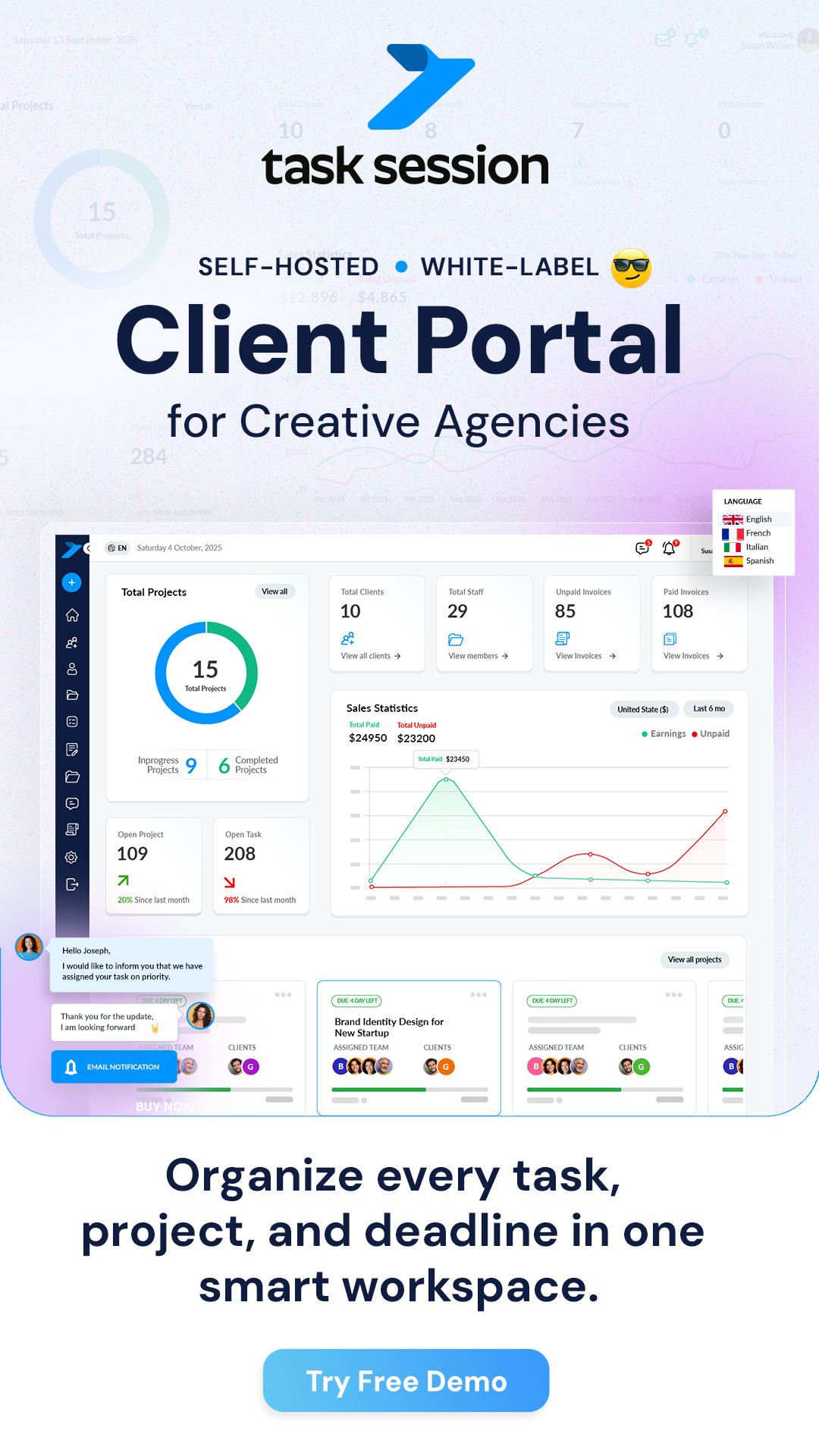
The Client Portal is one of Task Session’s most powerful features. It gives your clients a dedicated, branded space to track project progress, view and approve tasks, download files, pay invoices, and communicate with your team — all without needing access to your internal workspace. This guide walks you through enabling the portal, configuring what clients can see and do, onboarding your first client, and customising the experience to match your brand.
Who this guide is for: Admins setting up the Client Portal for the first time or looking to fine-tune what clients can access.
What you will need: Admin-level access, SMTP/email configured (for sending client invitations), and at least one project created.
What the Client Portal Does
The Client Portal is a separate, client-facing view of your Task Session installation. While your internal team works from the Admin and Staff panels, clients log in to a streamlined interface that only shows them what you have chosen to share.
From the Client Portal, your clients can:
- View project status and progress — see which projects they are involved in and how work is progressing.
- Track tasks — view tasks you have marked as client-visible, including statuses and due dates.
- Review and approve work — when Client Review is enabled, clients can approve deliverables or request revisions directly from the portal.
- Access files — view, download, and upload project files shared with them.
- View and pay invoices — see outstanding invoices and make payments through integrated payment gateways (Stripe, PayPal, or 2Checkout).
- Communicate with your team — send messages and participate in project discussions without leaving the portal.
Everything the client sees is controlled by you. Internal tasks, notes, financial settings, and team discussions remain hidden unless you explicitly make them visible.
Before You Begin: Prerequisites Checklist
Complete these steps before onboarding your first client. Each one ensures the portal works smoothly from day one.
| Prerequisite | Why It Matters | Status |
|---|---|---|
| Task Session installed and running | The portal is part of your installation — there is nothing separate to install. | ? |
| SSL/HTTPS enabled | Clients will be entering login credentials and making payments. HTTPS is essential for security and trust. | ? |
| SMTP/email configured | Client onboarding emails (login credentials, notifications) are sent via SMTP. Without it, clients will not receive their invitation. | ? |
| At least one project created | Clients are associated with projects. You need a project to assign them to. | ? |
| Payment gateways configured (optional) | If you want clients to pay invoices through the portal, set up Stripe, PayPal, or 2Checkout first. | ? |
| Branding configured (optional but recommended) | Your logo, brand colours, and custom domain make the portal look professional and trustworthy to clients. | ? |
Step 1: Add Your First Client
Every client who accesses the portal needs a client account. Here is how to create one and send them access.
- Log in to Task Session with your Admin account.
- Navigate to the Clients section from the main menu.
- Click Add Client (or the equivalent button in your version).
- Fill in the client details:
- Name — the client’s full name or contact person name.
- Email — this becomes their login email. Make sure it is accurate.
- Company — the client’s business or organisation name.
- Any additional fields your version supports (phone, address, notes).
- Set the client’s permissions (see the next section for details on what to enable or restrict).
- Click Save.
When you save, Task Session sends an automatic email to the client with their login credentials and a link to the portal. The client can then log in and see any projects they have been assigned to.
Client did not receive the email? Check these in order: (1) Confirm your SMTP settings are working — send a test email from Task Session’s email configuration page. (2) Ask the client to check their spam/junk folder. (3) Verify you entered the correct email address. (4) Check that your sending domain has SPF and DKIM records configured to prevent deliverability issues. See Email Notifications Not Working? Here’s How to Fix It for a full troubleshooting walkthrough.
Step 2: Configure What Clients Can See and Do
This is the most important part of setting up the portal. Task Session gives you granular control over what each client can access. Get this right and your clients see a clean, professional workspace. Get it wrong and they may see internal tasks, or miss invoices they need to pay.
Permission Areas
| Area | What the Client Can Do | Recommendation |
|---|---|---|
| Projects | View project status, progress, and overview for projects they are assigned to. | Enable for all clients. This is the foundation of the portal experience. |
| Tasks | View tasks marked as client-visible. May also be able to comment on tasks. | Enable selectively. Use the internal/client-visible toggle on individual tasks to control what appears. |
| Client Review / Approvals | Review deliverables, approve tasks, or request revisions. | Enable for creative agencies, design projects, or any workflow where client sign-off is needed. |
| Files | View, download, and (optionally) upload files shared with the project. | Enable downloads for most clients. Enable uploads if clients need to send you assets or documents. |
| Invoices / Payments | View invoices, see payment status, and make payments through integrated gateways. | Enable if you invoice through Task Session. Ensure payment gateways are configured first. |
| Communication / Chat | Send and receive messages, participate in project-level discussions. | Enable for active projects where ongoing communication is needed. Keeps everything in one place instead of scattered emails. |
The Internal vs. Client-Visible Toggle
Permissions control what types of content a client can access. But within each project, you also have per-item control over visibility. This is one of Task Session’s most important features for managing client relationships.
When you create or edit a task, discussion, or file, you can mark it as:
- Internal only — visible to your team (Admin and Staff) but completely hidden from the client.
- Client-visible — visible to both your team and the client in their portal.
How to use this effectively: Keep internal discussions, draft deliverables, team notes, and cost estimates as internal-only. Switch items to client-visible when they are ready for the client to see — finished designs, status updates, approved milestones, and final files. This way, your client sees a polished, curated view of the project, not your behind-the-scenes process.
Setting Permissions Per Client
Task Session allows you to set permissions individually for each client. This means different clients can have different levels of access based on the nature of your relationship.
For example:
- A retainer client who works with you monthly might have full access — projects, tasks, files, invoices, chat, and review/approval capabilities.
- A one-off client might only need to see project status, download final files, and pay their invoice.
- A referred contact reviewing a proposal might only need to see a single project overview and file downloads.
Configure these during client creation (Step 1 above) or update them later by editing the client profile from the Clients section.
Step 3: Assign Clients to Projects
A client only sees projects they have been explicitly assigned to. Simply having a client account does not automatically grant access to all your projects.
- Navigate to the Projects section.
- Open the project you want to share with the client (or create a new project).
- In the project settings, look for the Client assignment field.
- Select the client (or multiple clients if the project involves more than one).
- Save the project.
The assigned client will now see this project in their portal. Task Session may also send an automatic email notification letting them know they have been added to a new project (depending on your notification settings).
Remember: Even after assigning a client to a project, the individual tasks and files within that project are still controlled by the internal/client-visible toggle. Assigning a client to a project gives them access to the project — but only to items you have marked as client-visible.
Step 4: Enable Client Review and Approvals (Optional)
If your workflow requires client sign-off — design approvals, document reviews, content sign-offs — enable the Client Review feature. This adds a structured approval workflow to your tasks.
How Client Review Works
- You toggle Client Review on a task — the task enters a review state and becomes visible to the client in their portal.
- The client is notified — they receive an alert (in-portal and/or via email) that a task is ready for their review.
- The client reviews the task and attached files — they can see the deliverables, descriptions, and any supporting materials you have shared.
- The client approves or requests revisions — if approved, the task moves forward. If revisions are needed, the client adds comments explaining what should change.
- Your team updates and resubmits — staff members make the changes, update the task, and resubmit it for another round of review if needed.
This creates a clear, documented approval trail — you always know what was approved, when, and by whom. No more ambiguous email threads or lost feedback.
Best Use Cases for Client Review
- Creative agencies — design comps, brand assets, video edits, website mockups.
- SEO agencies — content drafts, audit reports, monthly deliverables.
- Law firms — document reviews, case file sign-offs, contract approvals.
- Marketing teams — campaign creatives, social media assets, ad copy.
Pro tip: You do not have to enable Client Review on every task. Use it selectively for deliverables that require explicit sign-off. Routine tasks (internal bug fixes, administrative updates, team coordination) should stay internal-only.
Step 5: Brand Your Client Portal
By default, the Client Portal carries Task Session’s interface. If you want to present it as your own platform — especially important for agencies — you can apply full white-label branding.
What You Can Customise
| Element | Where to Configure | Impact |
|---|---|---|
| Logo | System Settings ? Branding | Replaces the Task Session logo with your own across the portal, login page, and invoices. |
| Colours / Theme | System Settings ? Branding | Match the portal’s colour scheme to your brand identity. Includes support for light and dark themes. |
| Custom domain | DNS settings + System Settings | Point a subdomain like portal.youragency.com to your Task Session installation. Clients see your domain, not a third-party URL. |
| Email templates | System Settings ? Email Templates | Customise the automated emails clients receive (onboarding, invoice sent, task assigned, etc.) to match your brand voice and remove Task Session branding. |
| Invoice branding | Invoice Settings | Add your logo, business name, address, and payment terms to invoices the client sees and downloads. |
For a complete branding walkthrough, see Setting Up White-Label Branding and Using a Custom Domain for Your Client Portal.
What Your Client Sees After Logging In
Once a client logs in to the portal, they land on a streamlined dashboard tailored to their access level. Here is a breakdown of the typical client experience:
Project Overview
The client sees all projects they have been assigned to, with status indicators (active, on hold, completed). They can click into a project to see client-visible tasks, progress, deadlines, and milestones.
Tasks
Only tasks marked as client-visible appear here. The client sees the task name, status, due date, and any files attached. If Client Review is enabled, they see an approval interface to approve or request revisions.
Files
Shared project files appear in an organised file area. Clients can view, download, and (if permitted) upload files. Internal-only files are not shown.
Invoices and Payments
Clients see their invoices with statuses — sent, viewed, paid, or overdue. If a payment gateway is configured, they can pay directly through the portal via a secure payment link.
Messages and Discussions
If communication access is enabled, the client can send messages, reply to project discussions, and stay in touch with your team without switching to email.
Monitoring Client Activity
Task Session tracks client activity so you have visibility into how your clients are engaging with the portal. Depending on your version, the activity data may include:
- Login history — when the client last logged in and how frequently.
- IP address — the IP addresses used to access the portal.
- Session duration — how long the client spent in the portal per session.
- Actions taken — files downloaded, invoices viewed, tasks reviewed, messages sent.
This data is valuable for understanding which clients are engaged and which might need a nudge. If a client has not logged in after you have sent deliverables or invoices, you know to follow up directly.
Troubleshooting Common Client Portal Issues
| Problem | Likely Cause | Fix |
|---|---|---|
| Client did not receive login email | SMTP not configured, email went to spam, or wrong email address entered. | Verify SMTP settings, ask client to check spam, confirm the email address, and resend the invitation. |
| Client cannot see a project | Client was not assigned to that project. | Open the project settings and add the client to the project’s client assignment field. |
| Client cannot see specific tasks | Tasks are set to internal-only. | Edit each task and toggle it to client-visible. |
| Client cannot see invoices | Invoice permissions are not enabled for that client, or the invoice is not linked to their project/account. | Check the client’s permission settings and ensure the invoice is associated with their client profile. |
| Client cannot upload files | File upload permission is not enabled for the client role, or server upload limits are too low. | Enable file upload in client permissions. Also check PHP upload_max_filesize and post_max_size on your server. |
| Portal not loading or showing errors | URL misconfiguration, SSL issue, or caching problem. | Confirm the portal URL is correct, SSL is active, and try clearing browser cache. See Client Portal Not Loading? Troubleshooting Steps. |
| Client’s name or email is wrong | Data was entered incorrectly during setup. | Edit the client profile from the Clients section. See Editing and Deactivating User Accounts. |
Client Portal Setup Checklist
Use this checklist to confirm everything is in place after completing the setup:
? SMTP / email sending is configured and tested.
? SSL / HTTPS is active on your Task Session installation.
? At least one client account has been created and the invitation email was received.
? Client permissions are configured (projects, tasks, files, invoices, chat, review).
? Client is assigned to the correct project(s).
? Tasks and files within the project are toggled to client-visible where appropriate.
? Client Review is enabled (if your workflow requires approvals).
? Payment gateways are configured (if clients will pay invoices through the portal).
? Branding is applied — logo, colours, custom domain, email templates (optional but recommended).
? You have logged in as a test client to verify the portal experience from the client’s perspective.
Critical step: Before inviting real clients, create a test client account using your own email and log in to the portal yourself. Walk through the experience as if you were the client — check that you can see the right projects, tasks, and files, that invoices appear correctly, and that the branding looks professional. Fix anything that is off before your clients see it.
Frequently Asked Questions
Can multiple clients be assigned to the same project?
Yes. A project can have multiple clients and multiple team members. Each client sees the same client-visible content for that project, subject to their individual permission settings.
Can I have multiple contact persons for one client company?
Yes. You can create separate client accounts for different people at the same company and assign them all to the relevant project. Each person gets their own login and their own view of the portal.
Can clients create tasks or projects on their own?
By default, clients do not create projects or tasks — they view and interact with what your team has shared. If your workflow requires clients to submit requests, use the communication/chat feature or the Client Review workflow to capture their input.
Does the Client Portal cost extra?
No. The Client Portal is included in all Task Session plans at no additional charge. You can add unlimited clients on any plan — Single, Lifetime, or Multi.
Can I use Google Login for client accounts?
Yes, if you have configured Google Login (OAuth) in your Task Session settings. New users who sign in via Google are assigned the Client role by default. You can control whether Google-based registration is enabled or disabled from the admin settings.
What is the difference between the Client Portal and the Admin Panel?
The Admin Panel is the full Task Session interface — used by your team (Admins and Staff) to manage projects, tasks, invoices, settings, and all internal operations. The Client Portal is a restricted, client-facing view that only shows information you have chosen to share. Clients never see the Admin Panel.