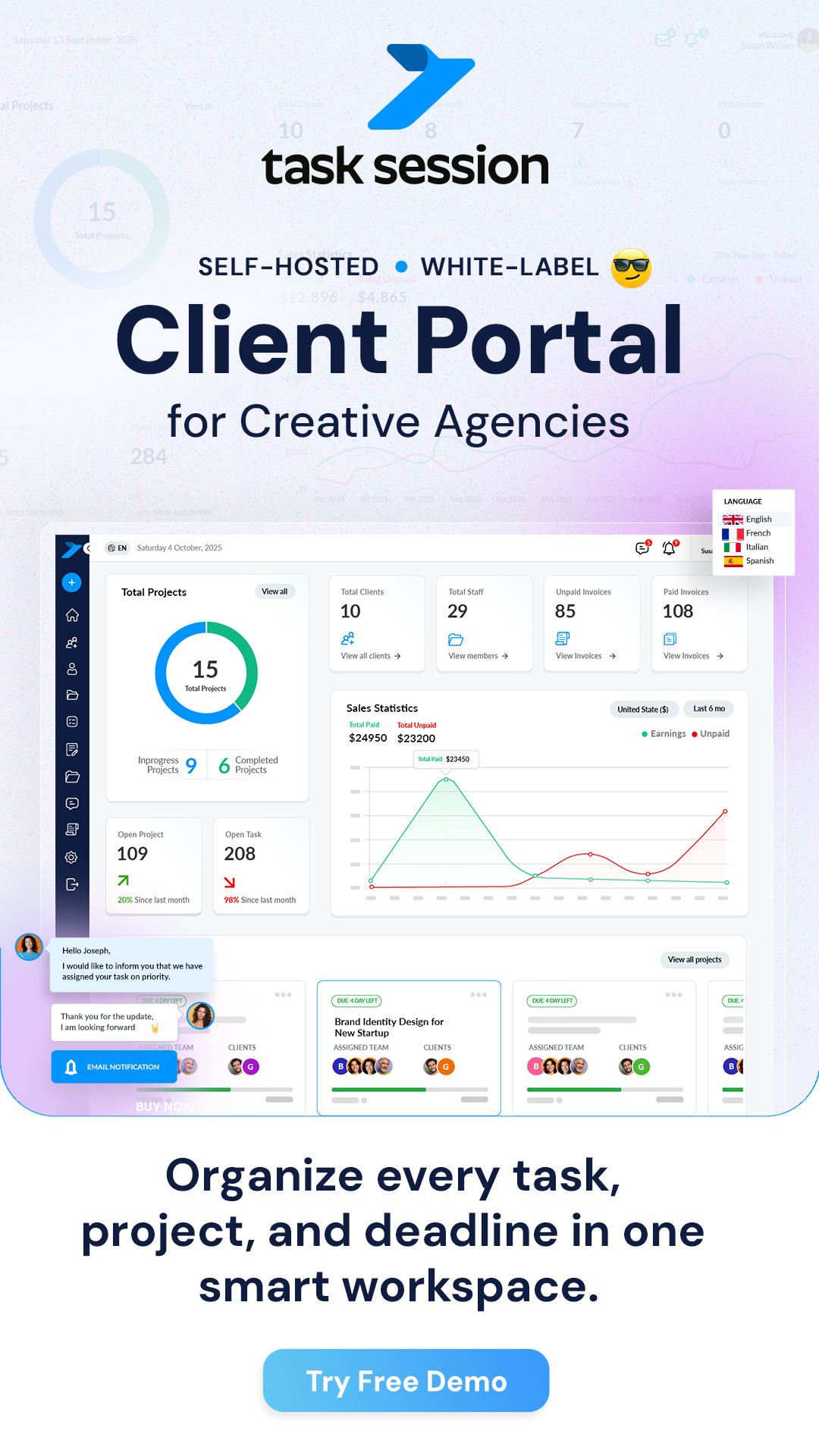
One of the most common questions from Task Session admins is “what exactly does my client see when they log in?” This guide answers that question by walking through the entire Client Portal experience from the client’s perspective. You will see what the login process looks like, what appears on the client dashboard, how projects and tasks are displayed, where invoices and files show up, and how the messaging system works for clients. Understanding this view helps you set up permissions correctly and present a polished, professional workspace to every client.
Who this guide is for: Admins and project managers who want to understand the client-facing experience before onboarding clients. Also useful as a reference to share with clients who need help navigating the portal.
Before you read: This walkthrough assumes the Client Portal has been set up and at least one client account has been created and assigned to a project. If you have not done this yet, start with Setting Up the Client Portal and Adding and Managing Clients.
The Login Experience
When a client is added to Task Session, they receive an email containing their login credentials and a link to the portal. Clicking that link takes them to the Task Session login page.
What the Client Sees on the Login Page
The login page presents two fields — email address and password — along with a “Forgot your password?” link for self-service password recovery. If you have configured white-label branding, the login page displays your logo and brand colours instead of the default Task Session branding. If Google Login is enabled, clients also see an option to sign in with their Google account.
After entering their credentials, the client is taken directly to their portal dashboard.
What clients do not see: Clients never see the Admin Panel, Staff Panel, system settings, internal team members, other client accounts, or any data from projects they are not assigned to. The login page routes them exclusively to the Client Portal view.
The Client Dashboard
After logging in, the client lands on their dashboard. This is their home base — a summary view that gives them a snapshot of everything relevant to their account. The dashboard is intentionally simpler than the admin dashboard. It only shows information the client has permission to access.
What Appears on the Dashboard
The exact layout depends on the permissions you have configured for each client, but a typical client dashboard includes the following areas.
Project Summary
The dashboard shows all projects the client has been assigned to, along with their current status — active, on hold, or completed. If the client is assigned to multiple projects, each one appears as a separate entry. The client can click into any project to see its details.
This gives the client an immediate answer to the question “where do things stand across all my projects?” without needing to dig deeper.
Recent Activity
The client may see a feed of recent activity related to their projects — new tasks marked as client-visible, files shared, invoices sent, or messages received. This helps them quickly identify what has changed since their last login without having to check each project individually.
Invoice Overview
If the client has invoice permissions enabled, they see a summary of their billing status — how many invoices are outstanding, any overdue amounts, and recent payments. This is particularly useful for finance contacts who log in primarily to check and pay invoices.
What the Client Does Not See on the Dashboard
The client dashboard does not include any of the following, regardless of their permissions:
- Internal-only tasks — tasks you have not toggled to client-visible stay completely hidden.
- Other clients — clients cannot see that other client accounts exist, even on shared projects.
- Staff-only discussions — internal team conversations are not exposed.
- System settings or configurations — nothing related to your Task Session setup, hosting, integrations, or billing is visible.
- Financial data beyond their own invoices — clients see their invoices only, never revenue summaries, payment gateway settings, or other clients’ billing information.
The Project View
When a client clicks into a project from the dashboard, they enter the project detail view. This is where they spend most of their time in the portal — tracking progress, reviewing deliverables, and communicating with your team.
What the Client Sees Inside a Project
| Section | What the Client Sees | Controlled By |
|---|---|---|
| Project Overview | Project name, description, current status (active, on hold, completed), and deadline if one has been set. | Visible to any client assigned to the project. |
| Tasks | Only tasks marked as client-visible. Each task shows its name, status, due date, and priority. Internal-only tasks are completely hidden. | Per-task internal/client-visible toggle, plus client permission for task access. |
| Milestones | Key project milestones with target dates and completion status. Helps the client understand the project timeline at a glance. | Milestone visibility settings on the project. |
| Files | Project files that have been shared with the client. The client can view and download files. If upload permission is enabled, they can also upload files to the project. | Client file permissions, plus which files are shared at the project level. |
| Invoices | Invoices linked to this project and client. Shows status (sent, viewed, paid, overdue), amounts, and due dates. If a payment gateway is configured, the client can pay directly from here. | Client invoice permissions, plus invoice association with the project. |
| Discussions / Chat | Project-level discussions the client has been included in. The client can read messages, reply, and share files in the conversation. | Client communication permissions. |
Important: What appears inside a project depends on two layers of control working together. First, the client’s account-level permissions determine which types of content they can access (tasks, files, invoices, chat). Second, the per-item visibility toggle controls which specific tasks and files within the project are shown. A client will only see an item if both layers allow it.
How Tasks Appear to Clients
When a client views the tasks section of a project, they see a curated list of deliverables and action items — only the ones you have chosen to share.
What the Client Sees on Each Task
- Task name — the title of the task as you wrote it. Keep task names clear and client-friendly if you plan to make them visible.
- Status — the current Kanban column the task sits in (for example, To Do, In Progress, Under Review, Completed). This gives the client a clear sense of where things stand.
- Due date — when the task is expected to be completed.
- Priority — the urgency level assigned to the task.
- Description and notes — any details or context you have added to the task body.
- Attached files — files uploaded to the task that are shared with the client.
- Comments — if the client has comment permissions, they can read and post comments on the task, creating a threaded conversation about that specific deliverable.
What the Client Does Not See on Tasks
- Internal-only tasks — any task not toggled to client-visible is completely invisible. The client has no indication it exists.
- Staff assignments — depending on your settings, the client may not see which specific team member is assigned to the task. They see the task and its status, not your internal resourcing.
- Internal comments — if your team has internal-only discussions on a task, those stay hidden from the client view.
Naming tip: Since clients see task names directly, avoid internal shorthand or technical jargon on client-visible tasks. Instead of “Fix homepage H1 tag hierarchy per audit,” consider “Homepage heading structure update” — it communicates the same work without exposing your internal process language.
The Client Review and Approval Experience
If you have enabled Client Review on specific tasks, the client sees an additional layer on those tasks — an approval interface that lets them formally sign off on deliverables or request changes.
What the Client Sees During a Review
When a task is submitted for client review, it appears in the client’s portal with a review prompt. The client can:
- View the deliverable — the task description, attached files (designs, documents, reports), and any context your team has provided.
- Approve the task — the client clicks an approval action to confirm the work is accepted. The task status updates and your team is notified.
- Request revisions — the client adds comments explaining what needs to change. The task returns to your team’s workflow for updates. Once revised, your team can resubmit it for another round of review.
This creates a documented approval trail within Task Session. Both sides have a clear record of what was submitted, when, what feedback was given, and when final approval was granted.
How the Review Cycle Looks from the Client’s Side
Step 1: Client receives a notification that a task is ready for review.
Step 2: Client opens the task in the portal, reviews the description and attached files.
Step 3: Client either approves the task or leaves revision comments.
Step 4: If revisions are requested, the client waits for your team to update and resubmit.
Step 5: The cycle repeats until the client approves.
Keep in mind: Client Review is optional and applies per task, not globally. If you do not enable it, clients simply view tasks and their statuses without an approval interface. Enable it only where formal sign-off adds value to your workflow.
How Invoices Appear to Clients
If invoice permissions are enabled, the client has a dedicated invoices section in their portal. This is where they manage their billing relationship with you.
What the Client Sees on Each Invoice
| Invoice Element | What the Client Sees |
|---|---|
| Invoice number and date | A unique invoice reference number and the date it was issued. |
| Line items | A breakdown of the services or deliverables being billed, with descriptions, quantities, and unit prices. |
| Taxes and discounts | Any applicable tax amounts or discounts applied to the invoice total. |
| Total amount | The final amount due, displayed in the currency configured for your installation. |
| Due date | When payment is expected. Overdue invoices are flagged with a distinct status so the client can see at a glance what needs attention. |
| Status | Current invoice state: sent, viewed, paid, or overdue. Status updates automatically as the client interacts with the invoice. |
| Payment action | If a payment gateway is configured (Stripe, PayPal, or 2Checkout), the client sees a Pay Now button or payment link that takes them through a secure payment flow. |
| Your branding | If you have configured invoice branding, the client sees your logo, business name, address, and payment terms on the invoice rather than default Task Session branding. |
Invoice Statuses from the Client’s Perspective
| Status | What It Means for the Client |
|---|---|
| Sent | The invoice has been created and delivered. The client has not yet opened it in the portal. |
| Viewed | The client has opened the invoice in the portal. Payment has not yet been made. |
| Paid | Payment has been received and recorded. The client sees this as confirmation their payment went through. |
| Overdue | The due date has passed and payment has not been received. The invoice is flagged so the client can see it requires immediate attention. |
Clients only see invoices addressed to them. They cannot see invoices for other clients, revenue totals, or any of your financial reporting data.
How Files Appear to Clients
The files section gives clients access to project deliverables, documents, and assets you have chosen to share.
What the Client Can Do with Files
- Browse files — files are organised within the project, typically in folders or a flat list depending on how you have structured them.
- View file details — file name, type, size, upload date, and who uploaded it.
- Download files — the client can download any file shared with them to their local device.
- Upload files — if upload permissions are enabled, the client can upload files to the project. This is useful for receiving assets, signed documents, or feedback files from the client.
What the Client Does Not See
- Internal-only files — files that have not been shared with the client are hidden.
- Files from other projects — even if the client is assigned to multiple projects, each project’s files are kept separate. The client only sees files within the project they are currently viewing.
- Media management tools — the admin-side storage dashboard, cleanup tools, and file statistics are not visible to clients.
File naming matters: Since clients see file names exactly as you upload them, use clear, descriptive names for client-facing files. A file named “AcmeCorp_Logo_Final_v3.png” is far more professional and useful than “final-FINAL2-updated.png”. Establish a naming convention with your team before sharing deliverables.
How Messages and Discussions Appear to Clients
If communication permissions are enabled, the client has access to a messaging area where they can interact with your team directly within Task Session. This keeps project-related conversations in one place instead of scattered across email threads.
Types of Communication the Client Can Access
| Communication Type | What the Client Experiences |
|---|---|
| Project discussions | Conversations attached to a project. The client can read messages, post replies, and share files within the discussion thread. Useful for general project updates, questions, and feedback. |
| Task-level comments | Comments on individual tasks that are client-visible. The client can post feedback directly on a specific deliverable, keeping the conversation tied to the relevant work item. |
| Direct messages | One-on-one messaging between the client and your team members. Works like a private chat channel for conversations that do not need to be attached to a specific project or task. |
What the Communication Experience Includes
- Real-time messaging — messages appear instantly. Both sides see typing indicators when the other is composing a reply.
- File sharing in chat — clients can drag and drop files into conversations (subject to the upload size limit).
- Mentions and replies — the client can use mentions to direct a message to a specific team member and reply to individual messages in a thread.
- Searchable history — past conversations are preserved and searchable, so the client can go back and find earlier discussions.
- Offline notifications — if the client is not logged in when a message is sent, they receive an email notification (provided SMTP is configured) alerting them to the new message.
What the Client Does Not See in Messaging
- Internal team chats — conversations between your staff members are invisible to clients.
- Group chats they are not part of — clients only see conversations they have been explicitly included in.
- Admin or staff panels — the chat interface the client sees is part of their portal view, not the internal team workspace.
Notifications the Client Receives
Throughout their experience with the portal, clients receive notifications to keep them informed of activity. Notifications appear in two ways.
In-Portal Notifications
When the client is logged in, they see real-time alerts within the portal interface. These might include new messages, tasks submitted for review, invoices sent, or files shared. The client can act on them immediately by clicking through to the relevant item.
Email Notifications
When the client is offline, Task Session sends email notifications for key events. The exact emails a client receives depend on your notification settings, but common triggers include:
- New project assignment — the client is added to a project.
- Task ready for review — a task has been submitted for client approval.
- New message — someone has sent them a message or replied to a discussion they are part of.
- Invoice sent — a new invoice is available for them to view and pay.
- Payment reminder — an overdue invoice reminder (if you have configured reminders).
- File shared — a new file has been uploaded to one of their projects.
Reminder: Email notifications depend entirely on your SMTP configuration. If emails are not set up or are being blocked by spam filters, clients will miss these alerts. Test your email delivery before onboarding your first client. If you have applied white-label branding, notification emails display your logo and brand colours instead of Task Session defaults.
Client Portal vs. Admin Panel: A Side-by-Side Comparison
To summarise the difference between what your team sees and what clients see, here is a comparison of the two interfaces.
| Feature | Admin / Staff Panel | Client Portal |
|---|---|---|
| All projects | Visible (admins see all; staff see assigned projects) | Only projects the client is assigned to |
| All tasks | Visible (internal and client-visible) | Client-visible tasks only |
| Kanban board | Full board with all columns and all tasks | Client sees task statuses but not the full internal Kanban workflow |
| Invoices | All invoices for all clients | Only invoices addressed to the logged-in client |
| Financial reports | Revenue, receivables, payment history | Not visible |
| Files | All files, media management dashboard | Shared project files only |
| Chat and discussions | All team chats, client chats, and discussions | Only conversations the client is part of |
| User management | Add, edit, deactivate users | Not visible |
| System settings | Full access (branding, SMTP, payments, integrations) | Not visible |
| Other clients | Full client list visible to admins | Not visible — each client is completely isolated |
Tips for a Polished Client Experience
1. Test the portal as a client before going live
Create a test client account using your own email, assign it to a project, and log in. Walk through every section the client will see. Check that the right tasks are visible, files are accessible, invoices appear correctly, and branding looks professional. Fix anything that feels off before your real clients see it.
2. Apply white-label branding
First impressions matter. Upload your logo, set your brand colours, configure a custom domain if possible, and customise email templates. A branded portal builds trust and makes your business look established, even if you are a solo freelancer.
3. Be deliberate about what you make client-visible
Clients do not need to see every internal task or work-in-progress file. Use the internal/client-visible toggle strategically. Share milestones, completed deliverables, and items that need client input. Keep your internal process, drafts, and team coordination hidden.
4. Use clear, professional language on client-visible items
Task names, file names, and project descriptions are seen directly by the client. Avoid internal jargon, abbreviations, or casual shorthand. Write as if the client is reading over your shoulder — because in the portal, they are.
5. Keep invoices up to date
If clients can see invoices in their portal, make sure statuses are accurate. An invoice stuck on “sent” when payment has already been received looks unprofessional. Update payment statuses promptly so the client’s view always reflects reality.
6. Guide your client through the portal
Not every client will intuitively know how to navigate the portal, especially on first login. Consider sending a brief welcome message (via chat or email) pointing them to the key areas — their project, current tasks ready for review, and any outstanding invoices. A short orientation goes a long way.
Frequently Asked Questions
Can clients see each other?
No. Each client account is completely isolated. A client cannot see other client accounts, other clients’ projects, or any information that does not belong to them — even if multiple clients are assigned to the same project.
Can I control which specific tasks a client sees?
Yes. Every task has an internal/client-visible toggle. Only tasks you explicitly set to client-visible appear in the client’s portal. Internal-only tasks are completely hidden from clients.
Do clients see the Kanban board?
Clients see the status of tasks (reflecting which Kanban column a task is in), but they do not see the full Kanban board interface with drag-and-drop capabilities. The Kanban board is an internal workflow tool for your team.
Can clients create their own tasks or projects?
By default, no. Clients view and interact with content your team has created and shared. They can comment on tasks, participate in discussions, review and approve deliverables, upload files (if permitted), and pay invoices. They cannot create new projects, tasks, or invoices.
What happens if I change a task from client-visible to internal-only?
The task immediately disappears from the client’s view. Any comments the client previously made on that task are preserved in your admin view, but the client can no longer see or access the task.
Can clients download invoices as PDF?
This depends on your Task Session version and configuration. Many versions support PDF invoice generation, allowing clients to download a formatted invoice document for their records.
What if my client says they cannot see something I shared?
Check two things in this order. First, confirm the client is assigned to the correct project. Second, verify that the specific item (task, file, or invoice) is set to client-visible and not internal-only. Permission mismatches and visibility toggles are the most common causes of this issue. See Managing Client Access and Permissions for a detailed troubleshooting guide.