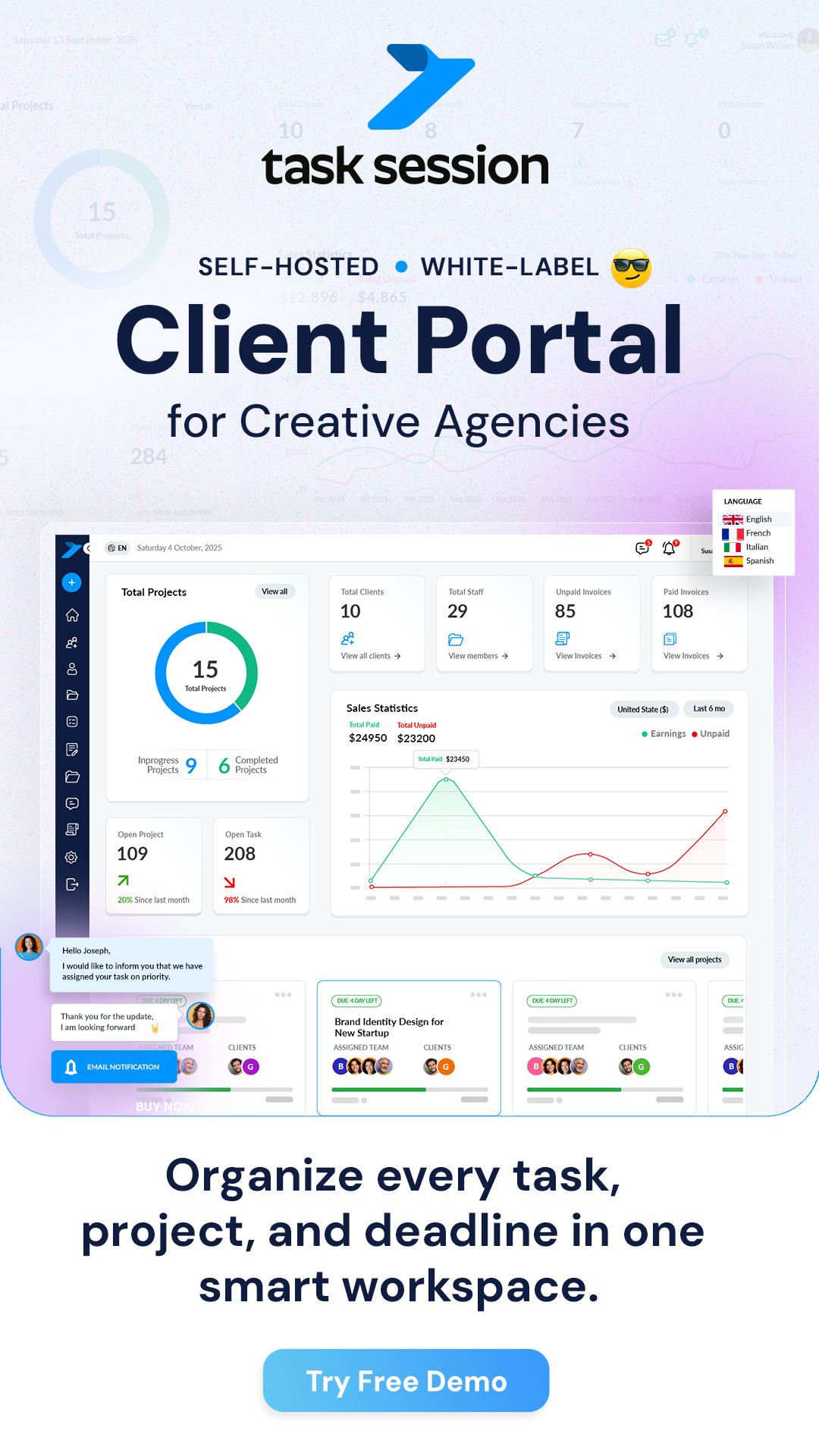
This page answers the most common questions about Task Session — from purchasing and licensing to installation, features, and support. If you are evaluating the product, setting it up for the first time, or troubleshooting an issue, start here.
For in-depth guides on specific topics, follow the links to related articles throughout this page.
Can’t find your answer? If your question is not covered here, visit the help center for detailed guides or contact Task Session support at tasksession.com/contact/.
General Questions
What is Task Session?
Task Session is a self-hosted project management and CRM platform designed for freelancers, agencies, and small-to-medium teams. It combines project management, task/Kanban workflows, client portal, invoicing, real-time chat, file management, and white-label branding into a single application that you install on your own server.
What does “self-hosted” mean?
Self-hosted means you install Task Session on your own web server rather than using a cloud service managed by someone else. You control the hosting, the data, and the infrastructure. This gives you complete data ownership, no dependency on a third-party SaaS provider, and the freedom to customise your installation.
Who is Task Session built for?
Task Session is designed for freelancers managing clients and invoices, creative and SEO agencies handling multiple client projects, law firms tracking cases and documents, marketing teams coordinating campaigns, IT teams managing sprints and bug tracking, and any small-to-medium team that wants project management without per-seat SaaS pricing.
How is Task Session different from tools like Asana, Monday, or ClickUp?
The biggest differences are: Task Session is self-hosted (your data stays on your server), it uses a one-time payment model (no monthly per-seat fees), it includes unlimited users on every plan, and it offers built-in invoicing and a white-label client portal. SaaS tools charge per user per month, store your data on their servers, and typically do not include invoicing or client portals.
What languages does Task Session support?
Task Session supports English, Spanish, Italian, and French. Language can be configured in your system settings.
Pricing and Licensing
What plans are available?
Task Session offers three plans:
- Single ($89/year) — 1 domain licence, 1 year of support. Best for freelancers and solo operators.
- Lifetime ($249 one-time) — 1 domain licence, 1 year of support. Best for growing businesses. Most popular plan.
- Multi ($359/year) — 5 domain licences, 1 year of top-tier support. Best for agencies with multiple clients.
All plans include the same features: unlimited projects, unlimited users, unlimited teams, custom roles and permissions, views and reporting, and the full installation wizard.
What does “Lifetime” mean?
Important clarification: The Lifetime plan’s licence is legally defined as five (5) years on the Task Session licence page (tasksession.com/license/). This means your licence is valid for five years from purchase. After that period, you would need to review renewal options. The plan is called “Lifetime” in marketing, but the licence page is the definitive legal interpretation.
Are there any hidden fees or per-seat charges?
No. All plans include unlimited users and unlimited teams. You can add as many team members and clients as you need without any additional per-seat cost. The price you see is the price you pay.
What is a domain licence?
Each licence is bound to a specific number of domains. The Single and Lifetime plans include 1 domain licence, meaning you can install Task Session on one domain. The Multi plan includes 5 domain licences. If you need to change your domain, check your account settings or contact support.
Can I use Task Session to offer it as a SaaS to others?
No. The standard licence prohibits using Task Session to create a SaaS service for third parties. It is licensed for your own business use.
What is the refund policy?
Task Session offers a 7-day limited refund policy. There are specific non-refundable reasons, which include purchasing the product under the misunderstanding that it is a WordPress plugin or a hosted SaaS service. Review the full refund policy at tasksession.com/refund-policy/ before purchasing.
Installation and Setup
What are the server requirements?
Task Session requires PHP 8 or higher, MySQL or MariaDB, specific PHP extensions, and SSL/HTTPS for production use and OAuth integrations. The application is lightweight at approximately 5 MB. For detailed requirements, see the System Requirements and Hosting Prerequisites article.
Can I install Task Session on shared hosting?
Yes. Task Session can be installed on shared hosting that meets the PHP and MySQL requirements. cPanel-based shared hosting is fully supported. See the Installing Task Session on Shared Hosting (cPanel) guide.
Can I install it on a VPS or dedicated server?
Yes. VPS and dedicated servers offer more control and better performance. You can configure Nginx or Apache, set up SSL, and optimise performance. See the Installing Task Session on a VPS or Dedicated Server guide.
How do I install Task Session?
Upload the files to your server, visit the /install/ path in your browser, complete the requirements check, configure your database credentials, set up your system basics, and create your admin account. The installation wizard guides you through each step.
Critical security step: After installation, you must delete the /install/ folder from your server. Leaving it in place creates a security vulnerability. This is explicitly documented and should not be skipped.
How long does installation take?
The installation process itself takes 5 to 10 minutes. Including server preparation (hosting setup, database creation, DNS configuration), the entire process typically takes 30 to 60 minutes for most users.
Features and Functionality
How many projects and tasks can I create?
There is no limit. All plans include unlimited projects, and there is no cap on the number of tasks per project.
What is the Client Portal?
The Client Portal is a separate, client-facing view of your Task Session installation. Clients log in to see their projects, track tasks, review and approve deliverables, view and pay invoices, download files, and communicate with your team. You control what each client can see and do through permissions and the internal/client-visible toggle.
What is the Kanban board?
The Kanban board is a visual workflow tool that organises tasks into columns representing stages (such as To Do, In Progress, Under Review, Completed). You drag tasks between columns as work progresses. Columns can be customised per project to match your team’s workflow.
Does Task Session have invoicing?
Yes. You can create invoices with line items, taxes, and discounts, send them to clients, and accept online payments through Stripe, PayPal, or 2Checkout. Invoices appear in the client’s portal, and the status updates automatically when payment is received through an integrated gateway.
Does Task Session have real-time chat?
Yes. Task Session includes project-based discussions, task-level comments, team chats, and 1:1 messaging with clients. Chat includes file sharing, mentions, replies, typing indicators, and searchable history. When users are offline, they receive email notifications (if SMTP is configured).
Can I use my own branding (white-label)?
Yes. All plans include white-label branding. You can replace the Task Session logo with your own, set brand colours, use a custom domain for the portal, customise email templates, and brand your invoices. Clients see your branding, not Task Session’s.
Does Task Session support recurring tasks?
Yes. You can set tasks to recur on a daily, weekly, monthly, or custom schedule. Each recurrence creates a new task instance with its own status, assignee, and due date.
Does Task Session support recurring invoices?
Yes. Recurring invoices can be set up for retainer clients or subscription-based services, automating the billing process for repeating engagements.
What payment gateways are supported?
Task Session supports Stripe, PayPal, and 2Checkout. Each is configured with API keys or account credentials in Payment Settings.
Does Task Session support multi-currency?
Yes. Multi-currency is supported. The currency is typically set at installation and applies to invoices generated within the system.
Is there a mobile app?
Task Session is a web-based application that works in mobile browsers. Check the roadmap at tasksession.com/roadmap/ for information on native mobile app plans.
Users, Roles, and Permissions
How many users can I add?
Unlimited. All plans include unlimited users (Admin, Staff, and Client accounts) with no per-seat charges.
What are the user roles?
Task Session has three built-in roles: Admin (full system access), Staff (limited to assigned projects, no system settings access), and Client (portal access to view projects, tasks, files, invoices, and communicate). You can also create custom roles with granular permissions across projects, tasks, files, communication, and financial modules.
Can clients see each other?
No. Client accounts are completely isolated. A client cannot see other clients, their projects, or their data.
Can I deactivate a user without losing their data?
Yes. Deactivating a user prevents them from logging in but preserves all their data — tasks, comments, files, invoices, and chat history remain intact. The account can be reactivated at any time.
Integrations
What integrations does Task Session support?
Task Session supports Google Login (OAuth) for single sign-on, Google Drive API for file management, Stripe, PayPal, and 2Checkout for payment processing, Contact Form 7 via webhook, and Zapier for connecting to thousands of other applications.
Do integrations require HTTPS?
Yes. Google Login (OAuth) and Google Drive both require HTTPS. Payment gateways also require HTTPS for secure transactions. SSL should be set up before configuring any integration.
Why am I getting a “redirect URI mismatch” error with Google Login?
The redirect URI configured in your Google OAuth console does not match the URI in your Task Session settings. Copy the redirect URI exactly from your Task Session settings (including https://) and paste it into the Google console. This is the most common integration issue.
Security and Data
Is my data secure?
Because Task Session is self-hosted, data security depends on your server configuration. Task Session includes role-based access control, session timeout, password policies, login attempt limits, and two-factor authentication options. You are responsible for server security, SSL, firewall configuration, and regular updates.
Does Task Session store data on third-party servers?
No. All data is stored on your server. Task Session does not send your project data, client information, or files to any external service. The only external connections are to payment gateways and Google services when those integrations are enabled.
What should I do after installing Task Session?
Delete the /install/ folder immediately, set strong admin passwords, configure login attempt limits, enable SSL, set up regular backups, and apply updates when they become available. See the Security Best Practices article for a complete checklist.
Does Task Session support two-factor authentication (2FA)?
Two-factor authentication is listed as a setting option. The specific implementation (TOTP app, SMS, or email-based) may vary by version. Check your system settings for 2FA configuration options.
Updates and Maintenance
How do I update Task Session?
Task Session offers one-click updates from the admin dashboard. When a new version is available, you will see a notification. Always back up your database and files before updating. See the How to Update article for step-by-step instructions.
How often are updates released?
Check the changelog at tasksession.com/changelog/ for the release schedule. Updates include feature additions, bug fixes, and security patches. Security updates should be applied immediately.
Will updating delete my data?
No. Updates modify application code and may run database migrations (adding new tables or columns), but they do not delete existing data. Always back up before updating as a precaution.
How do I back up my data?
Export your database using phpMyAdmin (for shared hosting) or mysqldump (for VPS/command line), and download your files via FTP or a tar/zip command. See the Backing Up Your Task Session Data article for full instructions.
Common Issues
I see a white screen or 500 error after installation.
Common causes include a PHP version that does not meet requirements, missing PHP extensions, incorrect file permissions, or .htaccess conflicts. Check your server error logs, verify PHP version is 8+, set directory permissions to 755 and file permissions to 644, and ensure required PHP extensions are enabled.
My client did not receive their login email.
This is almost always an SMTP configuration issue. Verify that SMTP is configured correctly in system settings, send a test email to confirm delivery works, ask the client to check their spam/junk folder, and verify the email address is entered correctly in the client profile.
Payments are failing or I see “invalid API key.”
This typically means the wrong API keys are entered (test keys instead of live keys, or vice versa), the payment gateway account is not fully set up, or the redirect/callback URL does not match. Double-check your API keys in Payment Settings and ensure you are using live keys for production.
My client cannot see a task, file, or invoice.
Check two things: first, confirm the client is assigned to the correct project. Second, verify that the specific item is set to client-visible (not internal-only). The internal/client-visible toggle and per-client permissions are the most common causes of this issue.
Google Drive integration shows a token error.
Expired or revoked tokens cause this. Go to System Settings, re-authorise the Google Drive connection, and confirm your OAuth credentials are still valid. Also check that your server’s SSL certificate is active and not expired.
File uploads are failing.
Check the file size against the upload limit (documentation cites 5 MB for chat uploads). Also check your server’s PHP upload_max_filesize and post_max_size settings, and verify the upload directory has correct write permissions.
I forgot my admin password.
Use the “Forgot your password?” link on the login page (requires SMTP). If email is not configured, you can reset the password directly in the database via phpMyAdmin. See the Forgot Admin Password article for detailed steps.
Getting Help
How do I contact Task Session support?
Visit tasksession.com/contact/ to submit an inquiry, or log in to your account at tasksession.com/account/ to access the ticket system at tasksession.com/ticket/. Include your licence key, the version you are running, a description of the issue, and any relevant screenshots or error messages.
What is included in the support plan?
All plans include 1 year of support from the date of purchase. The Multi plan includes top-tier support. After the support period expires, check your account for renewal options.
Is there a community or forum?
Check the Task Session website for community resources, documentation, and blog posts. The docs section at tasksession.com/docs/ contains guides and tutorials, and the blog at tasksession.com/blogs/ includes additional resources.
Where can I see what features are planned?
The product roadmap is available at tasksession.com/roadmap/. It shows planned, in-progress, and completed features including items like calendar view, meet integration, attendance module, and lead pipeline board.