Who this is for: System Owner / Admin who has just completed installation
Goal: Walk through the essential first steps inside Task Session — from your first login to sending your first invoice — so you have a working, configured instance within minutes. This guide follows the exact order things should be done and links to detailed articles where you need more depth.
This guide assumes you have already installed Task Session on your server, deleted the /install/ folder, and can log in to your admin dashboard. If you have not completed installation yet, start with How to Install Task Session on Your Server.
The Quick Start Path
Here is the complete sequence you will follow. Each step builds on the one before it, so work through them in order:
- Log in and explore the admin dashboard.
- Set your timezone, currency, and language.
- Add your branding (logo, colours, invoice logo).
- Configure email (SMTP) so notifications work.
- Set up a payment gateway so you can invoice clients.
- Create your first staff user.
- Onboard your first client.
- Create your first project.
- Add tasks to the Kanban board.
- Send your first invoice.
You do not need to complete every step in one sitting. But the first five steps (system configuration) should be done before you invite anyone else to the platform. Steps six through ten can happen whenever you are ready to start working with your team and clients.
Step 1: Log In and Explore the Admin Dashboard
Visit your Task Session URL and log in with the admin email and password you created during installation. You will land on the Admin Dashboard — the central overview of your entire system.
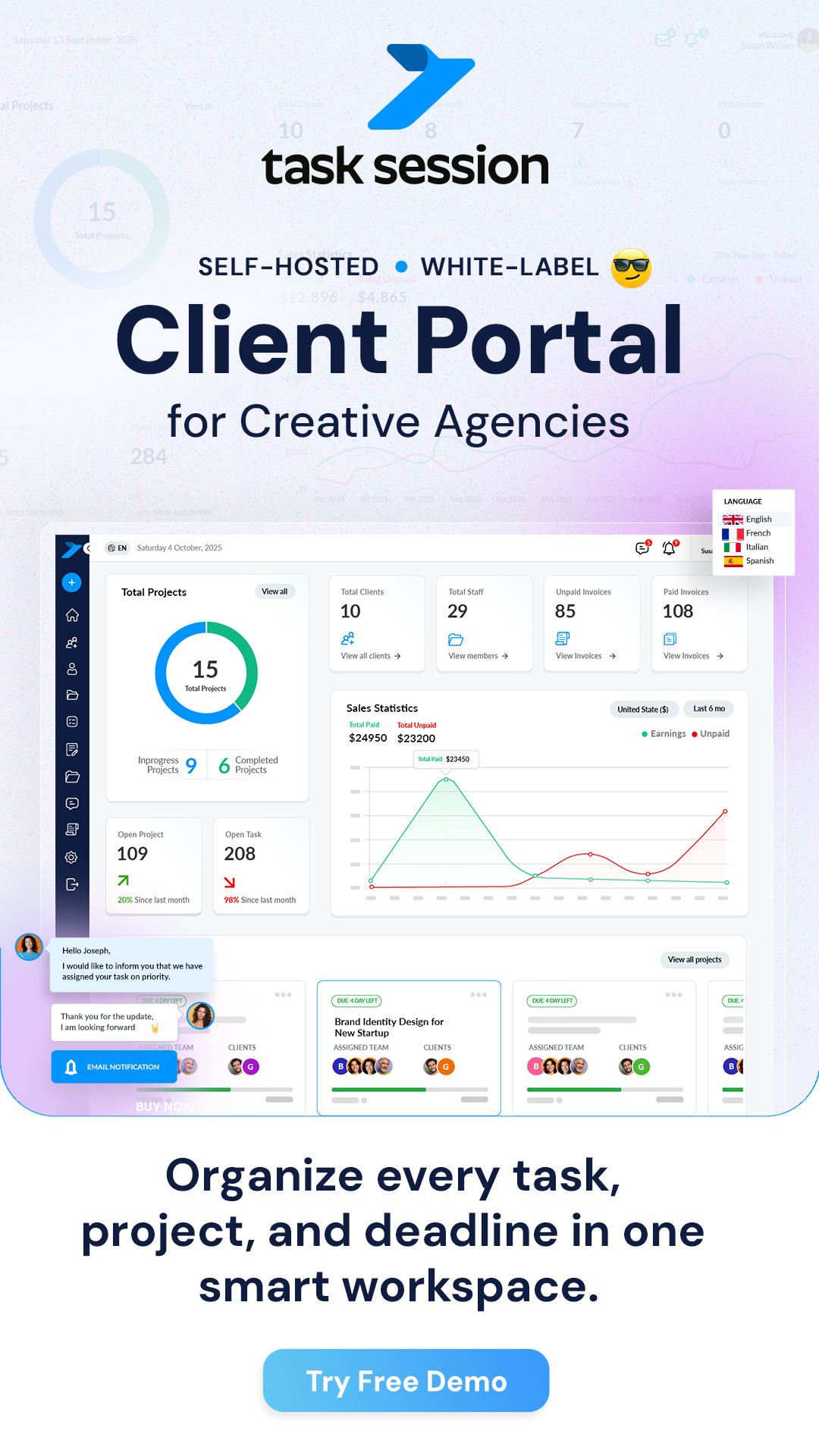
Take a moment to familiarise yourself with the main navigation. Depending on your version, the sidebar or top menu will include these core sections:
- Dashboard: Overview of projects, tasks, invoices, payments, team activity, and client activity.
- Projects: Where you create and manage all client and internal projects.
- Tasks: Your Kanban board view for managing task workflows.
- Clients: Client records, onboarding, permissions, and activity tracking.
- Invoicing: Create, send, and track invoices and payments.
- Files: Project file management and media storage.
- Chat: Real-time messaging for team and client communication.
- Notes: Internal documentation, meeting notes, and SOPs.
- Settings: System configuration, branding, roles, email, payments, and integrations.
Everything else in this guide happens inside these sections. You do not need to memorise the layout — just know that Settings is where most of your initial configuration happens.
Step 2: Set Your Timezone, Currency, and Language
These three settings affect everything in the system — task due dates, invoice dates, chat timestamps, financial reports, and the language your team and clients see in their interface.
- Go to Settings in your admin panel.
- Locate the general or system settings section.
- Set your Timezone to your operating timezone. All dates and times throughout the system will follow this setting.
- Set your Currency. This is the currency used on all invoices. Choose carefully — this is the default currency across the entire system.
- Set your Language. Task Session supports English, Spanish, Italian, and French. This controls the interface language for all users.
- Save your changes.
If you serve clients in multiple countries, choose the currency and timezone that match your primary business operations. Individual invoices can be managed separately, but the system default should reflect your main operating context.
For full details, see: Set Timezone, Currency, and Language.
Step 3: Add Your Branding
Task Session supports full white-label branding, so you can present the platform to clients as your own system — no Task Session branding visible anywhere.
- Go to Settings and locate the branding or white-label section.
- Upload your company logo. This appears in the dashboard header, login page, and client portal.
- Upload your invoice logo. This appears on all invoices and payment documents sent to clients.
- Set your colour theme. Choose colours that match your brand identity. Both light and dark theme options may be available depending on your version.
- Save your changes.
Your branding will immediately appear across the admin panel, staff workspace, and client portal. Clients logging into the portal will see your logo and colours — not Task Session’s.
For full details, see: White-Label and Branding Setup.
Step 4: Configure Email (SMTP)
Email is critical to how Task Session communicates with your team and clients. Without properly configured email, the following will not work reliably:
- Client onboarding invitations (login credentials sent to new clients).
- Project and task notifications (updates when things change).
- Invoice alerts (notifying clients of new or overdue invoices).
- Password reset emails.
- Chat offline alerts (messages received while someone is away).
How to configure:
- Go to Settings and locate the email or SMTP configuration section.
- Enter your SMTP server details: host, port, username, password, and encryption type (TLS or SSL).
- Set the “From” email address and “From” name that will appear on all outgoing notifications.
- Send a test email to verify delivery.
- If the test email lands in spam, configure SPF, DKIM, and DMARC DNS records for your sending domain.
If you are unsure which SMTP provider to use, common options include your hosting provider’s mail server, Gmail SMTP, Amazon SES, Mailgun, or Postmark.
Task Session also supports unbranded email templates as part of white-labelling — so notifications sent to clients carry your branding, not any third-party identity.
For full details, see: Configure Email / SMTP.
Step 5: Set Up a Payment Gateway
If you plan to invoice clients through Task Session (one of its most powerful features), you need to connect at least one payment gateway. Task Session supports three gateways:
- Stripe — Requires API keys (publishable key and secret key) from your Stripe dashboard.
- PayPal — Requires your PayPal Business account API credentials or PayPal email.
- 2Checkout — Requires your Seller ID and API credentials from your 2Checkout merchant account.
How to configure:
- Go to Settings and locate the payment gateway or payment settings section.
- Select the gateway you want to configure.
- Enter your API keys or credentials.
- If available, test the connection using sandbox or test mode before going live.
- Save your settings.
You can configure one gateway or all three. When creating invoices later, clients will be able to pay through whichever gateways you have enabled.
Important: Stripe and PayPal provide separate test and live API keys. Make sure you use the correct set — test keys for testing, live keys for production. Using test keys in production means payments will not actually process.
For full details, see: Configure Payment Gateways (Stripe, PayPal, 2Checkout).
Step 6: Create Your First Staff User
Now that your system is configured, you can start adding people. Staff users are your internal team members — designers, developers, project managers, assistants, or anyone who works on client projects.
- Go to the user management section of your admin panel (this may be under Settings or a dedicated Users section).
- Click the option to add a new user.
- Enter the staff member’s name, email address, and set a temporary password (or let the system generate one).
- Assign them the Staff role. This gives them access to assigned projects, tasks, chat, and file uploads — but not to system settings, financial data, or other admin-level features.
- Save the user. They will receive login credentials via email (this is why SMTP must be configured first).
Task Session includes unlimited users with every licence, so add as many staff members as you need without worrying about per-seat costs.
If you need more control over what specific staff members can access, you can create custom roles with granular permissions across projects, tasks, users, files, communication, and financial features. See: Create Custom Roles and Permissions.
Step 7: Onboard Your First Client
Clients access Task Session through the Client Portal — a separate, branded interface where they can track project progress, review tasks, communicate with your team, download files, view invoices, and make payments.
- Go to the Clients section of your admin panel.
- Click the option to add or onboard a new client.
- Fill in the client onboarding form with their details: company name, contact name, email address.
- Set their permissions. This controls what the client can see and do in their portal — which projects they can access, whether they can view tasks, files, invoices, and chat.
- Save the client. Task Session will automatically send them an email with their login credentials and a link to the client portal.
What the client sees: When they log in, they see only the projects they have been assigned to, along with the specific features you have enabled for them (tasks, files, invoices, chat). They will never see your internal tasks, other clients, or admin settings.
If the client does not receive their login email, check your SMTP configuration and ask the client to check their spam/junk folder. You can also resend the invitation from the admin panel.
Task Session supports multiple client users per company with different permissions — so you can give a client’s CEO read-only access while their project manager gets full collaboration permissions.
For full details, see: Onboard a Client and Send Portal Access.
Step 8: Create Your First Project
Projects are the central organising unit in Task Session. Everything — tasks, files, discussions, milestones, and invoices — lives inside a project.
- Go to the Projects section.
- Click the option to create a new project.
- Enter a project name and description.
- Set a deadline if the project has a due date.
- Assign the client you onboarded in Step 7. This gives them portal access to this specific project.
- Assign staff members who will work on the project.
- Save the project.
When you create a project and assign clients and team members, Task Session can send instant email notifications to let everyone know the project has been created and they have access.
From inside a project, you can access all related features: tasks, files, discussions, milestones, and invoices — everything for this engagement lives in one place.
For full details, see: Create Projects With Clients and Team Members.
Step 9: Add Tasks to the Kanban Board
Tasks are how work gets done. Inside your project, you will find the Kanban board — a visual workflow where tasks move through columns from left to right as they progress.
- Open the project you just created.
- Go to the Tasks or Kanban view.
- You will see default columns such as To Do, In Progress, Review, and Done. These represent the stages of your workflow.
- Click the option to add a new task in the “To Do” column.
- Enter a task name, set a due date, assign it to a staff member, and set a priority level.
- Save the task. It appears as a card in the Kanban column.
- To move a task forward, drag and drop it from one column to the next.
Key features to try:
- Internal vs client-visible tasks: You can control whether a task is visible to the client or kept internal-only. This is useful when some work steps are for your team’s eyes only.
- Custom columns: You can rename the default columns or add new ones to match your specific workflow (e.g., “Client Review,” “QA,” “Waiting on Client”).
- Task details: Click on any task card to open its detail view, where you can add notes, comments, subtasks, file attachments, and chat in context.
- Recurring tasks: For work that repeats (weekly reports, monthly audits), you can set tasks to recur automatically.
- Client Review: Toggle the client review feature on a task to notify the client that something is ready for their approval. The client can then approve or request changes through the portal.
For full details, see: Kanban Basics: Columns, Status, and Drag-and-Drop and Client Review and Approvals.
Step 10: Send Your First Invoice
This is the final step in the quick start path — and the one that closes the loop from “project created” to “client pays.”
- Go to the Invoicing section (or create an invoice from within a project).
- Click the option to create a new invoice.
- Select the client and project this invoice is for.
- Add line items — description, quantity, rate, and any applicable taxes.
- Set the due date for payment.
- Add any notes for the client (e.g., payment terms, project reference).
- Save and send the invoice.
What happens next:
- The client receives an email notification with a link to view the invoice.
- The invoice appears in the client portal under their invoices section.
- The client can view the invoice details and pay online through whichever payment gateway you configured (Stripe, PayPal, or 2Checkout).
- When the client pays, the invoice status updates automatically (sent, viewed, paid, overdue).
You can also set up recurring invoices for retainer clients and automated payment reminders for overdue invoices — reducing the manual work of chasing payments.
For full details, see: Create and Send Your First Invoice.
What You Have Accomplished
If you have followed all ten steps, your Task Session instance is now:
- Configured with your timezone, currency, language, and branding.
- Connected to email (SMTP) for reliable notifications and client communication.
- Integrated with at least one payment gateway for invoicing.
- Staffed with at least one team member who can log in and start working.
- Client-ready with at least one client onboarded to the portal with the correct permissions.
- Operational with a live project, tasks on the Kanban board, and an invoice sent to a client.
This is a fully working project management and client billing setup — built on your own server, under your own brand, with no per-seat fees.
What to Explore Next
Now that the foundations are in place, here are the features worth exploring as you get comfortable with the platform:
Communication
- Project discussions: Start a conversation inside a project that all assigned team members and clients can see.
- Task-level chat: Comment on specific tasks to keep conversations in context.
- Team and 1:1 chat: Real-time messaging with your team, separate from project discussions.
- Client messaging: 1:1 chat with individual clients through the portal.
For details, see: Chat and Discussions: Best Practices.
File Management
- Project files: Upload and organise deliverables in folder/subfolder structures per project.
- Client file sharing: Share files securely through the client portal.
- Media management: Monitor storage usage and clean up old files from the admin dashboard.
- Google Drive integration: Optionally connect Google Drive for extended file handling.
For details, see: Upload, Organise, and Share Files Securely.
Advanced Workflows
- Custom Kanban columns: Rename columns or add new ones per project to match different workflows.
- Personal columns: Create private Kanban columns visible only to you.
- Milestones: Track project phases, deadlines, and link payments to delivery milestones.
- Recurring tasks: Automate repetitive work items.
- Client review and approvals: Use the client review toggle to send tasks for client sign-off.
For details, see: Advanced Kanban: Custom and Personal Columns and Client Review and Approvals.
Integrations
- Google Login (OAuth): Allow team members and clients to log in with their Google accounts. New Google users default to Client accounts — you control whether new registrations via Google are allowed.
- Google Drive API: Connect Google Drive for file storage and sharing within projects.
Both integrations require HTTPS and a Google Cloud Console project with OAuth 2.0 credentials. For details, see: Set Up Google Login (OAuth) and Set Up Google Drive Integration.
Security and Maintenance
- Roles and permissions: Create custom roles beyond Admin, Staff, and Client to match your organisational structure.
- Login policies: Configure login attempt limits, session timeouts, and password policies.
- Two-factor authentication: Enable 2FA for admin and staff accounts.
- Updates: Check for and apply Task Session updates regularly through the admin panel.
- Backups: Ensure automated backups are running for your database and files.
For details, see: Post-Install Security Checklist and Update Safely With One-Click Updates.
Tips for Getting the Most Out of Task Session
- Set up before you invite. Complete all system configuration (Steps 1–5) before adding staff and clients. This ensures everyone’s first experience is polished — branded portal, working notifications, and functional invoicing from the start.
- Start with one client project. Run a single real project through the full cycle (create project, add tasks, share files, send invoice, receive payment) before scaling to multiple projects. This helps you iron out your workflow before it matters.
- Use internal-only vs client-visible. Not every task needs to be visible to the client. Use the visibility controls to keep internal work steps private while sharing milestones and deliverables.
- Configure payment reminders. Late payments slow down businesses. Set up automated reminders for overdue invoices so you do not have to chase clients manually.
- Keep the platform branded. Clients trust a platform that looks like yours. Take the time to set your logo, colours, and email templates — it makes a noticeable difference in how clients perceive your professionalism.
- Apply updates promptly. Task Session releases regular updates with security patches and feature improvements. Check the changelog at tasksession.com/changelog and apply updates as they become available. Always back up before updating.
Common Questions After First Login
Can I change the timezone, currency, or language later?
Yes. All three can be changed in Settings at any time. However, changing the currency after invoices have been created may cause confusion — it is best to set this correctly from the start.
How many users can I add?
Task Session includes unlimited users with every licence. There is no per-seat charge. Add as many admin, staff, and client users as your business requires.
What if my client does not receive the onboarding email?
First, verify your SMTP configuration is working by sending a test email from Settings. Then check with the client whether the email landed in their spam or junk folder. You can resend the invitation from the admin panel. If deliverability remains an issue, configure SPF, DKIM, and DMARC records for your domain, or switch to a transactional email service like Amazon SES or Mailgun.
Do I need to configure all three payment gateways?
No. Configure only the gateways you plan to use. One is enough to start invoicing and receiving payments. You can add additional gateways later.
Can clients see each other’s projects?
No. Clients only see the projects they have been specifically assigned to. Each client’s portal view is completely isolated — they cannot see other clients, other projects, or any internal team content.
Where do I go for help?
Task Session includes support for all licence holders. Submit a ticket at tasksession.com/ticket for assistance with any feature, configuration, or issue.