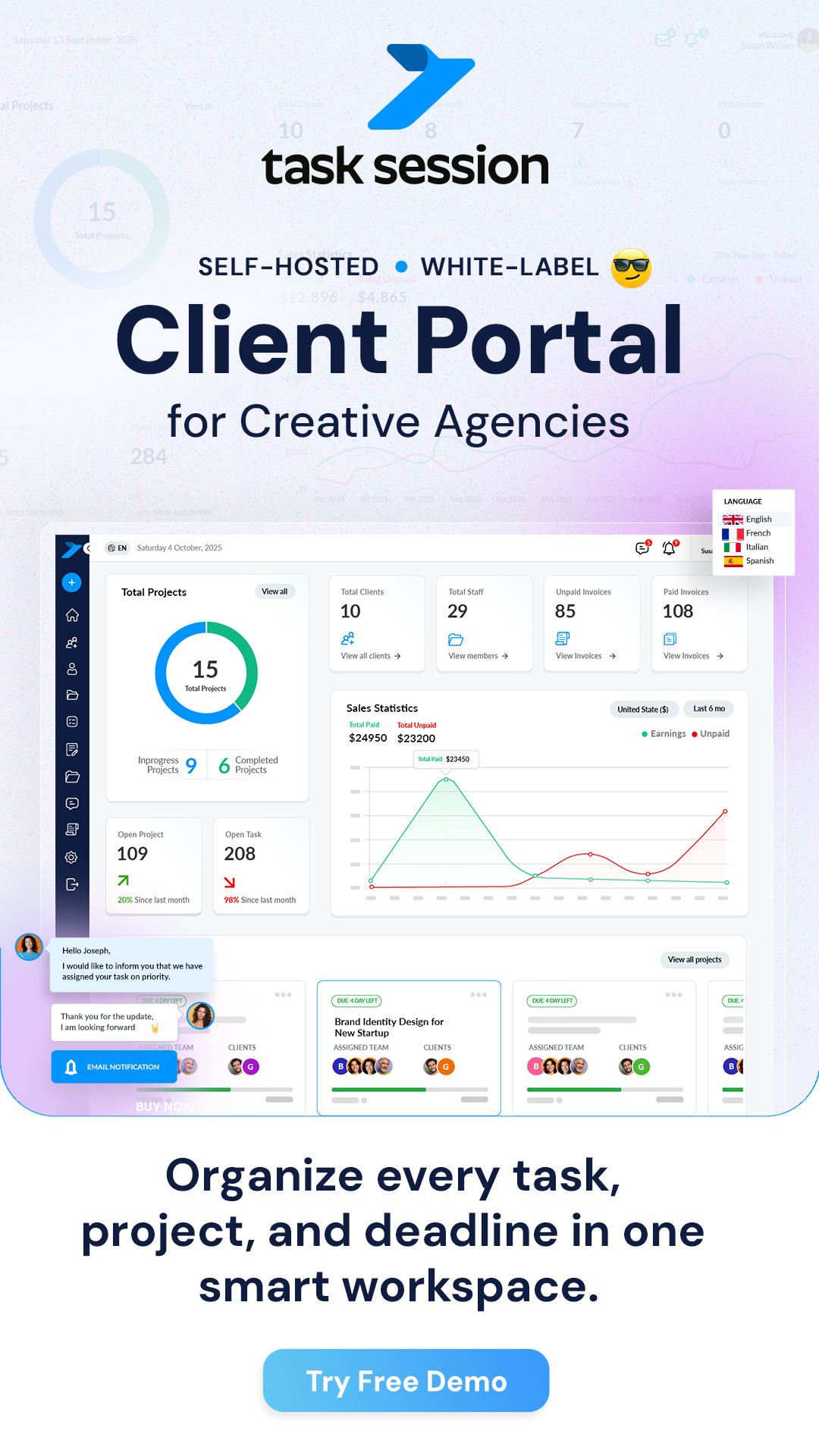
The Kanban board is your team’s visual command centre in Task Session. Instead of scrolling through a flat list of tasks, the Kanban board organises work into columns that represent stages of your workflow.
Tasks move from left to right — from To Do through In Progress, Under Review, and finally to Completed — giving everyone an instant, at-a-glance view of where every piece of work stands. This guide covers how to use the board, move tasks between columns, customise your workflow stages, and get the most out of visual project management.
Who this guide is for: Admins and Staff members working with tasks inside projects.
What you will need: At least one project with tasks created. Admin or Staff-level access.
What the Kanban Board Shows You
When you open a project and navigate to the Kanban view, you see a board divided into vertical columns. Each column represents a stage in your workflow. Tasks appear as cards within each column, and each card shows key information at a glance.
What Each Task Card Displays
| Element | What It Tells You |
|---|---|
| Task name | The title of the task — what needs to be done. |
| Assignee | Who is responsible for this task. |
| Due date | When the task is expected to be completed. Overdue tasks are flagged visually. |
| Priority | The urgency level (shown as a colour or icon). |
| Labels | Colour-coded tags for categorisation. |
| Subtask progress | If subtasks exist, a progress indicator shows how many are completed. |
Clicking on a task card opens the task sidebar or detail view, where you can see the full description, comments, attached files, and all other task details without leaving the board.
Moving Tasks Between Columns
The primary interaction on the Kanban board is dragging task cards from one column to another. This is how you update the status of a task as work progresses.
How to Move a Task
- Find the task card on the board.
- Click and hold the card.
- Drag it to the target column.
- Release.
The task’s status updates immediately. All team members viewing the board see the change in real time. If the task is client-visible, the client also sees the updated status in their portal.
Quick editing: You do not need to open a task to update its status. The drag-and-drop interaction is the fastest way to move work through your pipeline. For more detailed changes (reassigning, updating the description, adding comments), click the card to open the task sidebar.
Default Kanban Columns
When you create a new project, Task Session provides a set of default columns. These represent a standard workflow that works for most teams.
| Column | Purpose | Typical Tasks Here |
|---|---|---|
| To Do | Work that has been identified but not yet started. | New tasks, planned deliverables, upcoming work. |
| In Progress | Work that is actively being done by a team member. | Tasks someone is currently working on. |
| Under Review | Work that is completed but needs review before being marked done. | Deliverables waiting for internal or client review. |
| Completed | Work that is finished and approved. | Signed-off deliverables, closed tasks. |
You can customise these columns to match your team’s actual workflow. See the “Customising Your Columns” section below.
Customising Your Columns
Every team works differently. A design agency might use columns like Brief, Concept, Design, Client Review, Revisions, Approved. A development team might use Backlog, Sprint, Development, QA, Deployed. Task Session lets you create the workflow that matches how your team actually operates.
Adding a New Column
- Open the Kanban board for your project.
- Look for an Add Column option (typically at the far right of the board or in the board settings).
- Enter a name for the column.
- Save.
Renaming a Column
- Click on the column header or find the column’s edit option.
- Enter the new name.
- Save.
Reordering Columns
Drag column headers left or right to rearrange the order. The board reads left-to-right, so put your starting stage on the left and your final stage on the right.
Deleting a Column
Remove columns you no longer need. Before deleting, move any tasks from that column to another column first. Deleting a column with tasks in it may move those tasks to a default column or require you to reassign them.
Project-specific columns: Column configurations are project-specific. Customising columns in one project does not affect other projects. This means you can tailor the workflow to each client or engagement type.
Personal Columns
In addition to the shared project columns that everyone sees, Task Session supports personal columns. These are columns visible only to you, allowing you to organise your own view of the board without affecting what other team members see.
Personal columns are useful for adding stages like “My Priority” or “Waiting for Input” that are relevant to your personal workflow but do not need to be part of the shared project structure.
The Task Sidebar
When you click on a task card, a sidebar panel opens on the right side of the board. This sidebar gives you quick access to all task details without navigating away from the Kanban view.
What You Can Do in the Sidebar
- Edit the task name and description — make quick updates without opening a full page.
- Change the assignee — reassign the task to a different team member.
- Update due date and priority — adjust deadlines and urgency.
- Add comments — communicate with your team or client about the task.
- Attach files — upload deliverables, references, or assets.
- Toggle client visibility — switch between internal-only and client-visible.
- Enable client review — submit the task for client approval.
The sidebar keeps you in the flow of the board. You can update a task, close the sidebar, and immediately drag another card — all without page refreshes or navigation.
Filtering Tasks on the Board
When a project has dozens or hundreds of tasks, the board can become crowded. Filters let you narrow down what you see.
Common Filters
By assignee — show only tasks assigned to a specific person. Useful for checking someone’s workload or reviewing your own tasks.
By priority — show only urgent or high-priority tasks to focus on what matters most.
By label — filter by category (design, development, content) to see tasks of a specific type.
By due date — show tasks due this week, overdue tasks, or tasks within a specific date range.
By status — while the board already groups by column, status filters can help when combined with other criteria.
Kanban Board Workflows by Team Type
Here are proven column configurations for common team types. Use these as a starting point and adjust based on how your team actually works.
| Team Type | Recommended Columns | Why This Works |
|---|---|---|
| Freelancer / Solo | To Do, In Progress, Awaiting Client, Done | Simple four-stage flow. “Awaiting Client” separates completed work from work waiting on client feedback. |
| Creative Agency | Brief, Concept, Design, Client Review, Revisions, Approved | Accounts for the iterative creative process with built-in review and revision stages. |
| SEO Agency | Audit, On-Page, Off-Page, Reporting, Done | Maps to the standard SEO workflow from analysis through execution to reporting. |
| Development Team | Backlog, Sprint, Development, QA, Deployed | Follows agile-style workflow with a clear handoff between development and quality assurance. |
| Marketing Team | Ideation, Content Creation, Review, Scheduled, Published | Tracks content from concept through creation, review, and publication. |
Best Practices for Using the Kanban Board
1. Keep column count between 4 and 7
Too few columns and you lose visibility into where work actually stands. Too many and the board becomes cluttered and hard to scan. Four to seven columns covers most workflows without overwhelming your team.
2. Move tasks promptly
The board only works if it reflects reality. Encourage your team to move tasks as soon as their status changes. A board full of cards stuck in “To Do” when half the work is actually in progress helps nobody.
3. Keep the Completed column clean
Periodically archive or clear completed tasks. A long list of finished tasks at the end of the board adds visual noise and makes it harder to scan active work.
4. Use the board in team meetings
Walk through the board left-to-right during standups or status meetings. Each column becomes a natural discussion point: what is waiting, what is in progress, what is blocked, what is ready for review.
5. Name columns after outcomes, not activities
“Client Approved” is clearer than “Review.” “Ready to Deploy” is more specific than “Done.” Column names should tell anyone looking at the board exactly what it means for a task to be in that stage.
Frequently Asked Questions
Can clients see the Kanban board?
Clients do not see the full Kanban board interface with drag-and-drop. They see task statuses (which reflect the Kanban column) in their portal. The board itself is an internal workflow tool for your team.
Can I have different columns for different projects?
Yes. Column configurations are project-specific. Each project can have its own set of columns tailored to that particular workflow.
What happens if I delete a column that has tasks in it?
You will typically need to move tasks out of the column before deleting it, or the system will move them to a default column. Check the specific behaviour in your Task Session version before deleting columns with active tasks.
Can I limit how many tasks can be in a column?
Work-in-progress (WIP) limits are not explicitly documented as a feature. However, you can establish team conventions — for example, agreeing that no one should have more than three tasks in “In Progress” at any time.
Do Kanban columns affect reporting?
Yes. Task statuses derived from Kanban columns feed into the project analytics and dashboard. Completed columns contribute to progress tracking, and overdue tasks in any column are flagged in reporting.