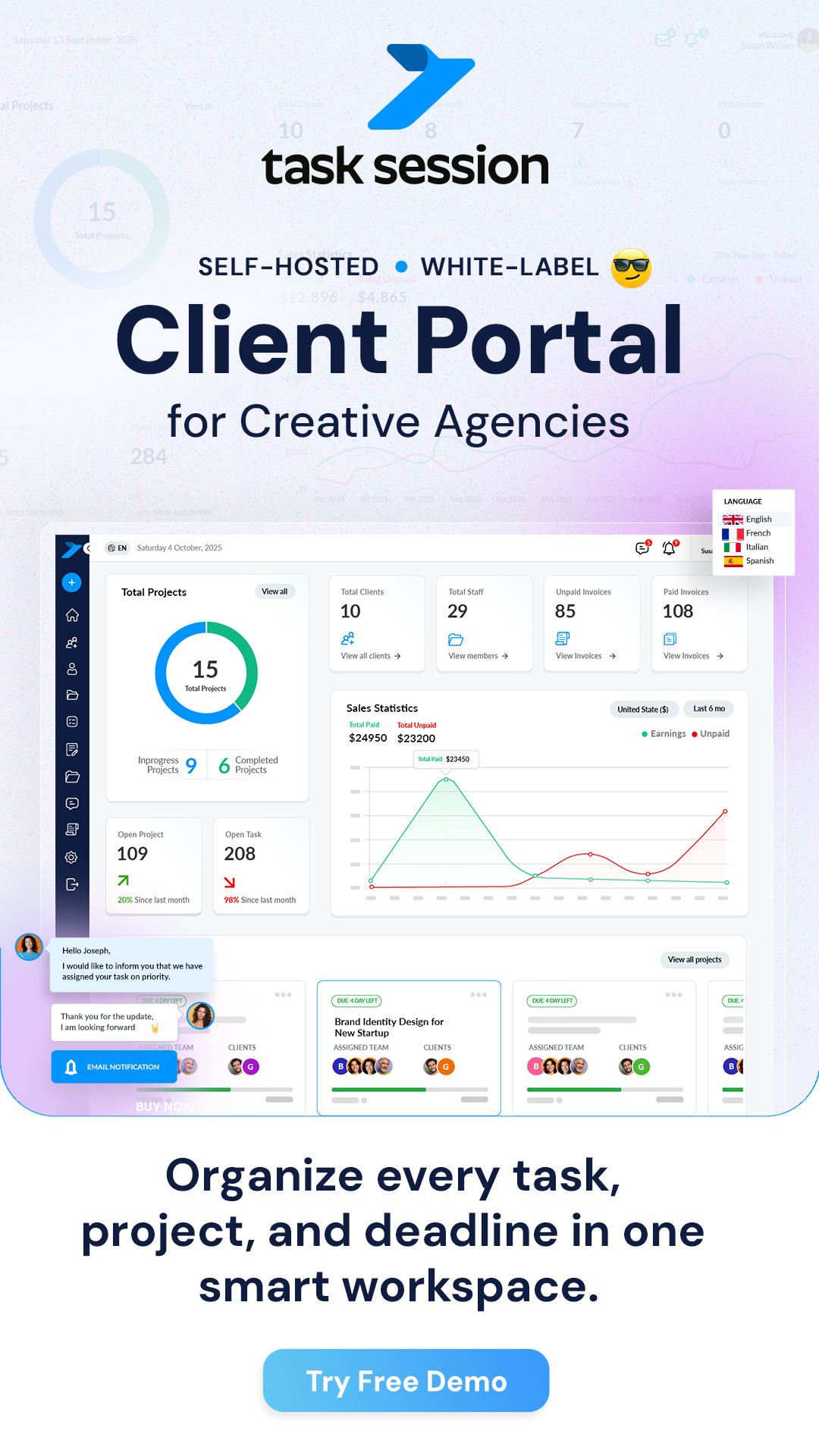
One of Task Session’s biggest advantages is unlimited users on every plan — no per-seat fees, no upgrade pressure as your team grows. Whether you have 3 people or 300, your cost stays the same. This guide walks you through how to add team members and clients, organise them with roles and permissions, and scale confidently without watching a billing meter.
Who this guide is for: Admins and account owners who want to add staff, clients, and collaborators to Task Session — and understand why it never costs extra to do so.
Why Unlimited Users Matters
Most project management and CRM platforms charge per user per month. That model creates a painful trade-off: either you limit who gets access, or your costs spiral as you grow. With Task Session, that trade-off disappears.
Every Task Session plan — Single, Lifetime, and Multi — includes:
- Unlimited team members — add designers, developers, project managers, assistants, and anyone else on your team.
- Unlimited client accounts — onboard as many clients as you need, each with their own secure portal access.
- Unlimited teams — create separate teams or departments without hitting a ceiling.
- Custom roles and permissions — control exactly who sees what, without paying for a “premium” permission tier.
Because Task Session is self-hosted on your own server, there is no usage-based metering. Your server, your rules.
The Cost Difference: Task Session vs. Per-Seat SaaS
To put the savings in perspective, here is what a 15-person team typically pays across popular SaaS platforms compared to Task Session:
| Platform | Pricing Model | Year 1 Cost (15 Users) | Year 3 Cost (15 Users) |
|---|---|---|---|
| Typical SaaS Tool A | ~$10/user/month | $1,800 | $5,400 |
| Typical SaaS Tool B | ~$16/user/month | $2,880 | $8,640 |
| Task Session (Lifetime) | $249 one-time | $249 | $249 |
| Task Session (Single) | $89/year | $89 | $267 |
| Task Session (Multi — 5 domains) | $359/year | $359 | $1,077 |
The difference is stark. With a per-seat SaaS tool, adding your 16th user increases your bill. With Task Session, adding your 16th — or 160th — user costs nothing extra.
How to Add Team Members and Clients
Adding users in Task Session takes just a few steps. Here is the process for both staff and client accounts.
Adding a Staff Member
- Log in to your Task Session admin panel.
- Navigate to the Users section from the main menu.
- Click Add User (or the equivalent button in your version).
- Enter the team member’s name, email address, and assign a role (Admin, Staff, or a custom role you have created).
- Save. The new user will receive an email with their login credentials (if SMTP is configured).
Adding a Client
- Go to the Clients section or use the client onboarding form.
- Enter the client’s name, email, and company details.
- Set the permissions — choose what the client can view, comment on, and access.
- Save. The client receives an email with portal login access.
Tip: Make sure your SMTP email settings are configured before adding users. If email is not set up, the onboarding invitations will not be delivered. See our guide on Setting Up Email Notifications for help.
Repeat these steps as many times as you need. There is no cap, no paywall, and no “upgrade to add more users” prompt.
Organising Users with Roles and Permissions
Adding unlimited users is only useful if you can control what each person sees and does. Task Session provides a structured role system to handle this.
Built-in Roles
| Role | Access Level | Typical Use |
|---|---|---|
| Admin | Full system access | Agency owners, system administrators. Manages users, projects, settings, finances, and payment gateways. |
| Staff | Assigned projects only | Designers, developers, assistants. Creates tasks, uploads files, communicates within project context. No access to system settings. |
| Client | Project-specific portal access | External clients. Tracks progress, views files and invoices, communicates with the team, makes payments. |
Custom Roles
If the built-in roles do not fit your workflow, you can create custom roles with granular permissions. Custom roles let you control access to specific modules:
- Projects — who can create, edit, or archive projects.
- Tasks — who can create, assign, or move tasks on the Kanban board.
- Files — who can upload, download, or delete files.
- Communication — who can access team chat, project discussions, or client messaging.
- Financial — who can view, create, or manage invoices and payment settings.
For example, you might create a “Project Manager” role that can manage projects and tasks but cannot access payment gateway settings. Or a “Bookkeeper” role with access to invoices and financial reports but no access to project files.
For more details: See Understanding User Roles & Permissions for a complete breakdown of what each role can do and how to build custom roles.
Best Practices for Scaling Your Team
As your team and client base grow, these practices will help you stay organised without things becoming unmanageable.
1. Plan Your Role Structure Early
Before adding dozens of users, decide on 3–5 roles that match your team structure. A typical agency setup might look like this:
- Admin — agency owner / operations lead (1–2 people)
- Project Manager — oversees projects, assigns tasks, communicates with clients
- Team Member — executes tasks, uploads deliverables, uses chat
- Finance — handles invoicing, tracks payments, generates reports
- Client — external stakeholders with portal access
2. Use the Client Portal to Reduce Access Confusion
Instead of giving clients staff-level access, always onboard them through the Client Portal. This ensures they only see what you want them to see — project status, relevant files, invoices, and messages — without accidentally accessing internal tasks, notes, or financial data.
3. Toggle Internal vs. Client-Visible Content
Task Session lets you mark tasks, discussions, and files as internal-only or client-visible. Use this toggle consistently so that as you add more clients, each one sees a clean, professional view of their project without internal noise.
4. Deactivate Instead of Deleting
When a team member leaves or a client project wraps up, deactivate their account rather than deleting it. Deactivation preserves all associated data — task history, chat logs, file uploads, and invoice records — while revoking login access. You can reactivate the account later if needed.
5. Review Permissions Periodically
As your user count grows, it is worth doing a quarterly review of who has access to what. Look for staff members who may have been granted Admin access temporarily and never had it revoked, or clients who still have active accounts after project completion.
Real-World Scenarios
Scenario 1: Freelancer Scaling from Solo to a Small Team
You start as a solo freelancer with 5 clients. Over six months, you bring on a virtual assistant and a part-time designer. With a per-seat SaaS tool, that is 2 new user fees added to your monthly bill. With Task Session, you simply add them — create their accounts, assign the Staff role, and link them to the relevant projects. Your cost stays at $89/year (Single) or $249 total (Lifetime).
Scenario 2: Agency Managing 20+ Clients
Your creative agency has 12 staff members and 25 active clients. On a typical SaaS platform charging $10/user/month, that is 37 users × $10 = $370/month or $4,440/year — and it goes up every time you win a new client. With Task Session, all 37 users (and any future ones) are included at no extra cost. Use the Client Portal with white-label branding to give each client a professional, branded experience.
Scenario 3: Multi-Domain Agency
You run separate white-labeled installations for different brands or business units. The Multi plan ($359/year) gives you 5 domain licences — each with unlimited users. That means 5 independent instances, each with their own branding, clients, and teams, all for less than what many SaaS tools charge for a single 10-person team.
Frequently Asked Questions
Is there really no user limit?
Correct. All Task Session plans include unlimited users — team members and clients. There is no hidden cap or throttle. Since the software runs on your own server, the only practical limit is your server’s capacity, which comfortably handles hundreds of users for most hosting setups.
Do I need to pay more as my team grows?
No. Your Task Session licence fee is the same whether you have 5 users or 500. There is no per-seat charge, no usage tier, and no “contact sales for enterprise pricing” gating.
Do client accounts count as users?
Client accounts are separate from staff accounts, but both are unlimited. You can onboard as many clients as your business requires, each with their own portal access and permissions.
What happens to data when I deactivate a user?
All data associated with the deactivated user — tasks, comments, files, chat history, and invoices — is preserved. The user simply loses the ability to log in. You can reactivate the account at any time to restore access.
Can different users have different permission levels?
Yes. Task Session supports both built-in roles (Admin, Staff, Client) and custom roles with granular permissions across projects, tasks, files, communication, and financial modules. You have full control over who sees and does what.