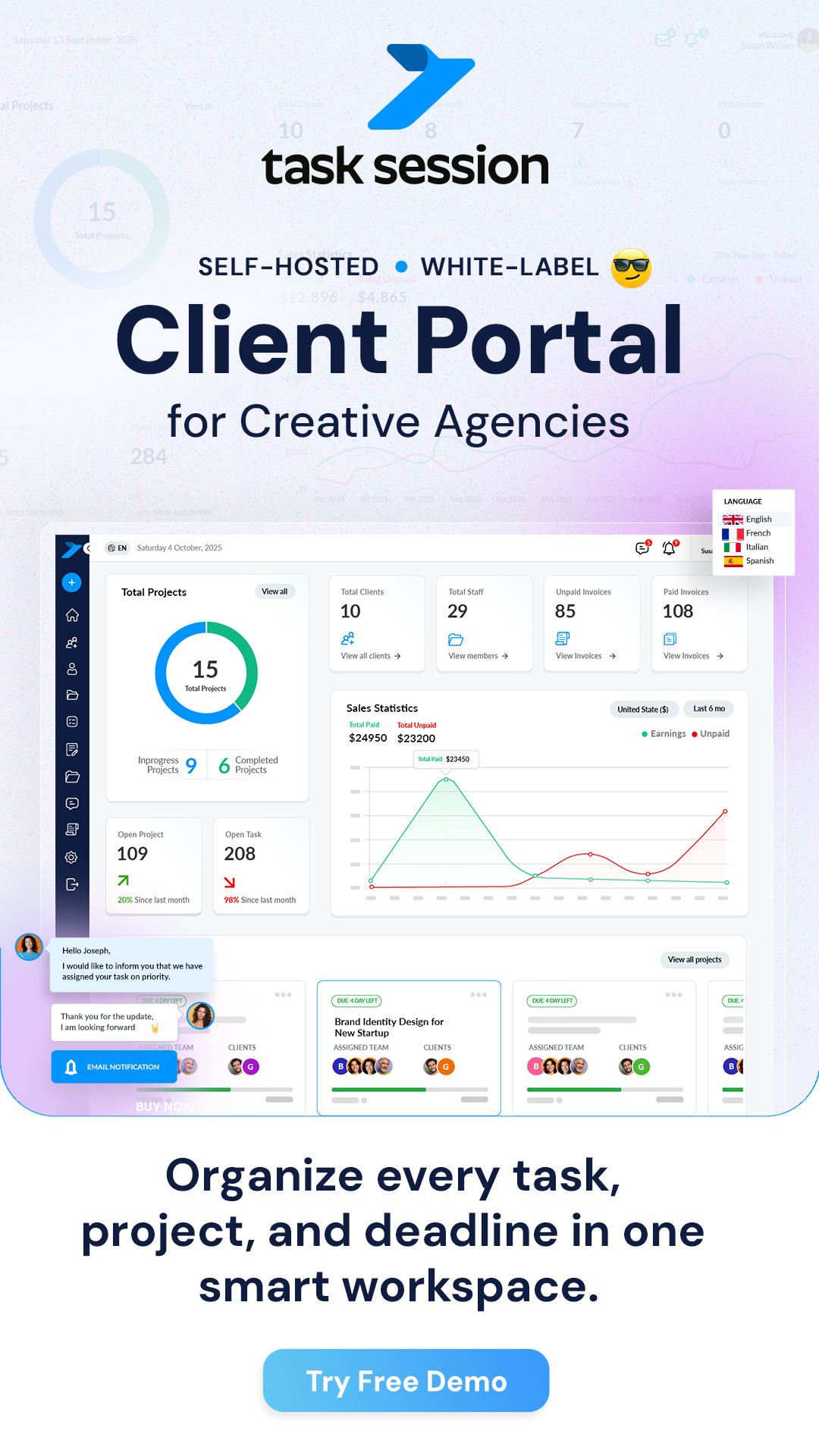
When your clients log in to the portal, the first thing they notice is how it looks — your logo, your colours, your domain. Task Session’s white-label branding lets you strip away all default branding and replace it with your own, so the portal feels like a custom platform built specifically for your business. This guide walks you through every element you can customise, from uploading your logo and setting brand colours to pointing a custom domain and editing the email templates your clients receive.
Who this guide is for: Admins who want to present the Client Portal as their own branded platform. Especially relevant for agencies managing multiple clients.
What you will need: Admin-level access to Task Session. For custom domain setup, you will also need access to your domain registrar or DNS management panel. For email branding, you will need SMTP configured.
Why White-Label Branding Matters
White-label branding is not just a cosmetic upgrade. It directly affects how clients perceive your business and the tools you use to serve them. Here is what professional branding accomplishes in the Client Portal.
Builds trust and credibility
Clients feel more confident working with a team that presents a consistent, professional brand. A portal with your logo, colours, and domain signals that you have invested in your systems and take your business seriously.
Eliminates third-party confusion
Without white-labelling, clients see Task Session branding and may wonder what this unfamiliar platform is. With your branding applied, the portal feels like a natural extension of your business — not a third-party tool they have been asked to learn.
Strengthens client retention
A branded portal reinforces your presence in the client’s workflow every time they log in, check a task, or pay an invoice. This ongoing visibility makes your relationship feel more embedded and harder to replace.
Supports premium pricing
Agencies that present a polished, branded client experience can command higher rates. The portal becomes part of your value proposition — not just a project management tool, but a client-facing platform that reflects the quality of your service.
What You Can Customise
Task Session gives you control over five branding areas. Each one targets a different touchpoint in the client experience.
1. Logo — Appears on the login page, portal header, navigation, and invoices.
2. Colours and theme — Affects the portal interface, buttons, navigation, and accents.
3. Custom domain — Changes the browser address bar, login page URL, and all portal links.
4. Email templates — Applies to every automated email the client receives (onboarding, invoice, task assignment, notifications).
5. Invoice branding — Appears on invoice documents the client views, downloads, or prints. Difficulty: Quick — configure in invoice settings.
You can tackle these in any order, but the sections below follow the recommended sequence:
logo first (instant visual impact), then colours, then domain, then emails, then invoices.
Step 1: Upload Your Logo
Your logo is the most visible piece of branding. It replaces the Task Session logo everywhere the client interacts with the portal.
How to Upload
- Log in to Task Session with your Admin account.
- Navigate to System Settings.
- Look for the Branding section (the exact label may vary slightly by version).
- Find the logo upload area. You may see separate fields for the main logo and a smaller logo or favicon.
- Upload your logo file.
- Click Save.
Where Your Logo Appears
- Login page — the first thing clients see before they enter the portal.
- Portal header and navigation — visible on every page as the client moves through projects, tasks, files, and invoices.
- Invoices — your logo appears on invoice documents the client views and downloads (this may also be configurable separately under invoice settings).
- Email notifications — if your email templates include the logo, it appears in automated emails as well.
Logo Best Practices
Use a PNG with a transparent background — Looks clean against both light and dark themes without a visible box around it.
Use a horizontal or square version of your logo — Navigation headers are typically horizontal. A tall vertical logo may get cropped or appear too small.
Keep the file size reasonable — A logo under 200 KB loads quickly and does not slow down page rendering for clients.
Test on both light and dark themes — If Task Session offers light and dark modes, make sure your logo is legible on both backgrounds. Some teams upload different versions for each theme.
Tip: After uploading your logo, open the portal login page in a private or incognito browser window. This clears any cached versions and shows you exactly what a new client will see on their first visit.
Step 2: Set Your Brand Colours and Theme
Colours shape the overall feel of the portal. Task Session lets you customise the colour scheme so the interface matches your brand identity rather than the default palette.
How to Configure
- Go to System Settings.
- Open the Branding section.
- Look for colour or theme settings. You may see options for primary colour, accent colour, sidebar colour, button colour, and overall theme mode (light or dark).
- Enter your brand’s hex colour codes or use the colour picker.
- Select your preferred theme mode — light or dark.
- Click Save.
What Changes
Brand colours typically affect the following elements across the portal:
1. Navigation bar and sidebar — background colour and text colour.
2. Buttons and links — primary action buttons (such as Pay Now on invoices, Submit Review, Send Message) adopt your primary colour.
3. Accent elements — highlights, status indicators, hover states, and selected items.
4. Overall background — light or dark mode sets the base tone for the entire interface.
Colour Selection Tips
Maintain contrast. Make sure text remains readable against your chosen background colours. Light text on a light background or dark text on a dark background makes the portal difficult to use. If you are unsure, test with a contrast checker tool before saving.
Use your primary brand colour sparingly. Your primary colour works best for action buttons and key highlights. Applying a bold colour to large areas (like the entire sidebar) can feel overwhelming. Use neutral tones for backgrounds and save your brand colour for elements you want to draw attention to.
Keep it consistent with your other touchpoints. Your portal colours should match your website, email signatures, and marketing materials. If your website uses a navy and white palette, the portal should feel the same. Consistency builds recognition and trust.
Step 3: Set Up a Custom Domain
By default, clients access the portal through your Task Session installation URL — something like yourdomain.com/path or a server IP address. A custom domain lets you replace this with a clean, branded URL like portal.youragency.com or projects.yourcompany.com.
This is the most technically involved branding step, but it makes a significant difference. Clients see your domain in the address bar, in bookmarks, and in every link you send them.
What You Need
- A domain or subdomain you control — for example, portal.youragency.com. Most teams use a subdomain rather than the root domain.
- Access to your DNS management panel — this is where you create the DNS record that points your subdomain to your server.
- An SSL certificate for the custom domain — HTTPS is required for security, client trust, and proper functionality (especially payment processing and Google OAuth integrations).
You can also read this article: How to Install Task session on Server
How to Set It Up
- Choose your subdomain.
Common choices include portal.yourdomain.com, projects.yourdomain.com, app.yourdomain.com, or clients.yourdomain.com. Pick something intuitive that your clients will recognise. - Create a DNS record. Log in to your domain registrar or DNS management panel. Create a CNAME record or an A record that points your chosen subdomain to your Task Session server’s IP address or hostname. An A record points the subdomain to a specific IP address (for example, portal.youragency.com pointing to 123.45.67.89). A CNAME record points the subdomain to another hostname (for example, portal.youragency.com pointing to youragency.com).
- Wait for DNS propagation. DNS changes can take anywhere from a few minutes to 48 hours to propagate globally. In most cases, it takes less than an hour.
- Install an SSL certificate. Set up SSL for your custom subdomain using Let’s Encrypt (free) or a paid SSL provider. If you are on shared hosting, many hosts provide one-click SSL installation through cPanel. On a VPS, you can use Certbot to generate and install a Let’s Encrypt certificate.
- Configure the domain in Task Session. Go to System Settings and update the site URL or domain field to reflect your new custom domain. Save the settings.
- Test thoroughly. Open the custom domain in a browser and confirm the portal loads correctly with HTTPS active. Log in with a test client account and verify that all pages, links, and payment flows work as expected.
Critical: SSL (HTTPS) is not optional. Without it, clients will see browser security warnings when they visit the portal, payment gateways will not process transactions, and Google OAuth integrations will fail. Always set up SSL before sharing the portal URL with clients.
Common DNS Issues
Problem: Custom domain does not load anything.
Likely Cause: DNS record not created or still propagating.
Fix: Verify the DNS record exists in your registrar. Wait up to 48 hours for propagation. Use a DNS lookup tool to check if the record is resolving.
Problem: Domain loads but shows a security warning.
Likely Cause: SSL certificate is not installed or does not cover the subdomain.
Fix: Install or renew the SSL certificate for the specific subdomain. Confirm the certificate covers the exact domain you are using.
Problem: Domain loads but portal shows errors or blank page.
Likely Cause: Task Session’s site URL does not match the custom domain.
Fix: Update the site URL in System Settings to match your custom domain exactly (including https://).
Problem: Payment gateways or Google Login stop working.
Likely Cause: OAuth redirect URIs and payment callback URLs still point to the old domain.
Fix: Update redirect URIs in your Google OAuth console and callback URLs in your payment gateway settings (Stripe, PayPal, 2Checkout) to use the new custom domain.
Important: If you change your domain after clients have already been using the portal, their bookmarks and saved login links will break. Notify clients of the new URL in advance and consider keeping the old URL temporarily redirecting to the new one.
Step 4: Customise Email Templates
Every automated email Task Session sends to your clients — onboarding invitations, invoice notifications, task assignments, chat alerts, payment reminders — is a branding touchpoint. By default, these emails may carry Task Session branding. Customising the templates ensures every email your client receives looks like it came from your business.
How to Edit Templates
- Go to System Settings.
- Open the Email Templates section (the exact label may vary by version).
- You will see a list of automated email types. Common templates include: Client onboarding / welcome email, Invoice sent notification, Payment received confirmation, Payment reminder / overdue notice, Task assigned notification, Task ready for review notification, New message notification, and Project assignment notification.
- Open a template to edit. You can typically modify the subject line, body text, and layout.
- Replace any default Task Session branding with your own — your business name, your logo (if the template supports inline images), and your brand voice.
- Save the template.
- Send a test email to yourself to preview how it looks in the client’s inbox.
Email Branding Best Practices
- Match your brand voice. If your business communicates in a friendly, conversational tone, your email templates should reflect that. If you are more formal and corporate, write accordingly. Consistency between your portal, your website, and your emails builds trust.
- Keep subject lines clear and actionable. Instead of “Notification from Task Session,” use something like “New invoice from [Your Business Name] — due March 15” or “[Your Business Name] — Your project has been updated.” Clients should know exactly what the email is about before they open it.
- Include your business name and contact details. Every email template should clearly identify who it is from. Add your business name, email address, and optionally a phone number or website link in the footer.
- Remove all default Task Session branding. Go through each template carefully and replace any mention of “Task Session” with your own business name. Check the header, footer, and body text.
- Test every template. After editing, trigger each email type (send yourself a test invoice, assign yourself to a project as a client, etc.) and check the result in your inbox. Verify that the formatting, links, logo, and text all look correct.
SMTP requirement: Email templates only work if SMTP is configured. Without SMTP, Task Session cannot send outgoing emails regardless of how the templates are designed. If your emails are not being delivered, see Email Notifications Not Working? Here’s How to Fix It before spending time on template customisation.
Step 5: Brand Your Invoices
Invoices are one of the most client-facing documents in your workflow. They are viewed in the portal, sent via email, downloaded, and sometimes forwarded to the client’s own accounting team. Every invoice should look like it came from your business.
What You Can Customise on Invoices
1. Invoice logo — Configure in Invoice Settings or Branding Settings. May use the same logo uploaded in general branding, or allow a separate invoice-specific logo. Some businesses use a wordmark on invoices for a cleaner look.
2. Business name — Configure in Invoice Settings. Your registered business name or trading name as you want it to appear on invoices.
3. Business address — Configure in Invoice Settings. Your physical or registered address. Important for legal compliance in many jurisdictions.
4. Payment terms — Configure in Invoice Settings. Default payment terms shown on invoices (for example, “Net 30” or “Due on receipt”). Can typically be overridden per invoice.
5. Custom fields or notes — Configure on the Invoice creation screen. Add tax registration numbers, purchase order references, bank details for wire transfers, or any standard footer note you include on all invoices.
Tip: After configuring invoice branding, create a test invoice and preview it exactly as a client would see it. Check the logo placement, text alignment, and how it looks when downloaded or printed. A misaligned logo or missing address on an invoice can undermine the professional image you are building everywhere else.
Complete White-Label Branding Checklist
Use this checklist to make sure every client touchpoint carries your branding. Work through each item in order.
- Upload your logo in System Settings and confirm it appears on the login page and portal header.
- Set your brand colours and choose a theme mode (light or dark). Save and preview the portal.
- Choose a custom subdomain and create the DNS record pointing to your server.
- Install an SSL certificate for the custom subdomain and verify HTTPS is active.
- Update the site URL in Task Session’s System Settings to match the new custom domain.
- Update OAuth redirect URIs (Google Login, Google Drive) and payment callback URLs (Stripe, PayPal, 2Checkout) to use the new domain.
- Open each email template in System Settings. Replace all Task Session branding with your business name, logo, and brand voice.
- Send a test email for each template type and verify formatting, links, and branding in your inbox.
- Configure invoice branding — logo, business name, address, payment terms, and any custom footer notes.
- Create a test invoice and preview it as a client would see it.
- Create a test client account using your own email. Log in to the portal and walk through every section — dashboard, projects, tasks, files, invoices, chat.
- Check the portal on mobile. Confirm your logo, colours, and layout look correct on smaller screens.
Before and After: What Changes for Your Client
1. Portal URL — Without white-label: Server IP or generic domain. With white-label: portal.youragency.com.
2. Login page — Without white-label: Task Session logo and default colours. With white-label: Your logo, your brand colours.
3. Portal interface — Without white-label: Default colour scheme. With white-label: Your brand palette and theme.
4. Email notifications — Without white-label: Generic templates with default branding. With white-label: Your business name, logo, and voice.
5. Invoices — Without white-label: Default layout, no business details. With white-label: Your logo, address, terms, and contact info.
6. Client perception — Without white-label: “They use some third-party tool.” With white-label: “They have their own professional platform.”
Troubleshooting Common Branding Issues
Problem: Old logo still appears after uploading a new one.
Likely Cause: Browser cache is showing the old version.
Fix: Clear your browser cache or open the portal in a private/incognito window. Ask clients experiencing the issue to do the same.
Problem: Logo appears stretched or blurry.
Likely Cause: Image dimensions or resolution do not match the display area.
Fix: Upload a higher-resolution version. Use a horizontal format with a transparent PNG background. Avoid logos smaller than 200 pixels wide.
Problem: Brand colours are not applying.
Likely Cause: Settings were not saved, or browser cache is showing old styles.
Fix: Confirm you clicked Save after changing colours. Clear cache and reload. If colours still do not apply, verify the hex codes are entered correctly.
Problem: Email notifications still show Task Session branding.
Likely Cause: Email templates have not been edited, or changes were not saved.
Fix: Open each email template individually, replace all default branding, save, and send a test email to verify.
Problem: Custom domain shows a browser security warning.
Likely Cause: SSL certificate is missing, expired, or does not cover the subdomain.
Fix: Install or renew the SSL certificate for the exact subdomain. Verify with a browser or SSL checker tool.
Problem: Invoices show default branding despite portal being branded.
Likely Cause: Invoice branding is configured separately from portal branding.
Fix: Go to Invoice Settings and configure the logo, business name, and address specifically for invoices. These may not inherit from the general branding settings automatically.
Frequently Asked Questions
Does white-label branding cost extra?
No. White-label branding is included in all Task Session plans — Single, Lifetime, and Multi. There is no additional charge for using your own logo, colours, domain, or customised email templates.
Can I use different branding for different clients?
Task Session applies one set of branding across the entire installation. All clients see the same logo, colours, and domain. If you need completely separate branding per client, you would need separate Task Session installations on different domains, each with its own licence.
Do I need a custom domain to use white-label branding?
No. A custom domain is one part of white-labelling, but it is not required. You can upload your logo, set brand colours, customise email templates, and brand your invoices without changing your domain. The custom domain is an additional step that removes the last visible reference to your hosting setup.
Will changing my domain break existing client bookmarks?
Yes. If clients have bookmarked the old URL, those bookmarks will stop working. Notify clients before the switch and provide them with the new login URL. If possible, set up a redirect from the old URL to the new domain so clients are forwarded automatically.
Can I use a root domain instead of a subdomain?
Technically yes, but a subdomain is usually the better choice. Using a root domain (like youragency.com) means your website and the portal share the same domain, which can create routing conflicts. A subdomain (like portal.youragency.com) keeps the portal cleanly separated from your marketing website.
How do I update my branding later if my company rebrands?
Follow the same steps in this guide. Upload a new logo, update colours, edit email templates, and update invoice settings. Changes take effect immediately after saving (though clients may need to clear their browser cache to see the new logo and colours). If your domain changes, update the site URL in System Settings and reconfigure any OAuth redirect URIs and payment callback URLs.